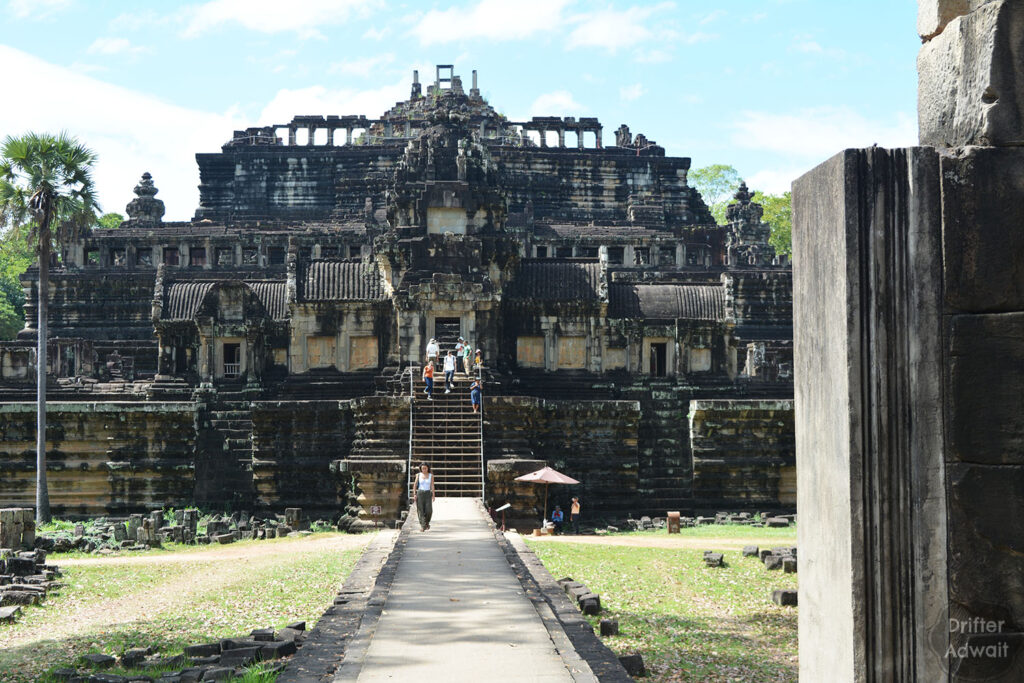
Long before the birth of Krishna, before the night when Vasudeva carried the divine child across the dark waters of the Yamuna, another story was already unfolding within the troubled kingdom of Kansa. The prophecy that Devaki’s eighth son would one day bring about the tyrant’s downfall is well known in the traditions surrounding the Krishna birth narrative. Yet the fate of the six children born before Krishna is rarely remembered. Who were those infants whose lives ended almost as soon as they began, and what place did their brief existence hold in the greater design that would lead to the incarnation of Krishna?
The answers lie within the Puranic accounts of Krishna’s birth, where the tragedy of Devaki’s six sons forms the dark prelude to the divine incarnation. Remarkably, this episode did not remain confined to the sacred texts of India. Thousands of kilometers away, upon the stone walls of the Baphuon temple in Cambodia, Khmer sculptors carved scenes that appear to preserve the same story—the fear of Kansa, the sorrow of Devaki, and the mysterious events that prepared the world for Krishna’s arrival.
The Forgotten Prelude to Krishna’s Birth
For no apparent reason—though perhaps for the unseen balance of the universe—the wandering sage Narada arrived one day at the distant outskirts of the kingdom ruled by the formidable Kansa. Such was often the way of Narada: appearing suddenly and quietly, yet always at moments when the currents of destiny were beginning to shift.
Kansa welcomed the sage with honor befitting a revered rishi. The king received him with ceremony and served him with every sign of respect and devotion, offering hospitality with all the grandeur of a royal court. Yet the visit, though courteous, carried with it the weight of something far greater than a mere exchange of pleasantries.
When the time came for Narada to depart, he spoke words that would linger long after he had gone.
With calm certainty the sage revealed that the Divine Lord himself would one day be born as the eighth child of Devaki, and that this very child would be the one destined to bring about Kansa’s death.
At first the king burst into laughter. The prophecy seemed absurd to him, and he dismissed it with the arrogant confidence of a ruler who believed his power to be unchallenged. Yet when Narada departed and the quiet of the palace halls returned, the echo of those words remained. Slowly, almost imperceptibly, the thought of his own death began to take hold of Kansa’s mind. What had begun as laughter soon turned into restless suspicion, and suspicion into a consuming dread.
In that darkening state of mind, the tyrant ordered his demonic allies—Keshi, Putana, and others—to spread havoc throughout his kingdom, as though the turmoil within his heart must also be reflected across the land he ruled.
Soon his attention turned toward Devaki, his own sister, who had been married to his trusted friend Vasudeva.
Kansa did not cast them into chains, yet their freedom became little more than an illusion. Devaki and Vasudeva were placed under vigilant watch, surrounded by spies loyal to the king who carefully observed their every movement. Kansa gave them strict instructions: whenever Devaki became pregnant, the days were to be counted carefully and he was to be informed at once. With cold pride he declared that none of her children would be allowed to live. Whether the first or the last, he swore that every child born to Devaki would meet the same terrible fate.
Kansa’s Order to Destroy Devaki’s Children
सोऽज्ञापयत संरब्धः सचिवानात्मनो हि तान् । यत्ता भवत सर्वे वै देवक्या गर्भकृन्तने ॥
प्रथमादेव हन्तव्या गर्भास्ते सप्त एव हि। मूलादेव तु हन्तव्यः सोऽनर्थो यत्र संशयः ॥
देवकी च गृहे गुप्ता प्रच्छन्नैरभिरक्षिता। स्वैरं चरतु विश्रब्धा गर्भकाले तु रक्ष्यताम् ॥
Consumed with anger and fear, Kansa then gave orders to his ministers and trusted attendants. They were to remain vigilant and prepare themselves to destroy the children conceived by Devaki. From the very first pregnancy onward, he declared, every child must be slain. Wherever there existed even the slightest threat to his safety, that danger must be eradicated at its root.
Devaki herself was to remain under constant watch within her palace. Though she might move about freely while not with child, hidden guards were to surround her dwelling at all times. Whenever she became pregnant, her movements were to be carefully controlled so that no child born to her might escape the king’s command.
Vishnu Considers the Fate of Devaki’s Children

While the kingdom trembled beneath the growing cruelty of its ruler, Shri Hari Vishnu observed all that was unfolding. For the divine plan to come to completion, the Lord himself would one day take birth as Devaki’s eighth son. Yet before that sacred moment could arrive, seven children would be born before him. The seventh could be sent as the Lord’s Anshavatara—Sankarshana, who would later be known as Balarama.
Yet another question arose within the Lord’s contemplation. What of the six children who would come before him? Must they suffer such a tragic fate without reason?
As the Lord pondered this, a memory stirred within him—an ancient story long buried within the past. Without delay, his thought turned toward the shadowed depths of Patala Loka, where the answer lay hidden.
The Demons Known as Shadgarbha
सप्तेमान् देवकीगर्भान् भोजपुत्रो वधिष्यति । अष्टमे च मया गर्ने कार्यमाधानमात्मनः ॥
तस्य चिन्तयतस्त्वेवं पातालमगमन्मनः । यत्र ते गर्भशयनाः षड्ङ्गर्भा नाम दानवाः ॥
विक्रान्तवपुषो दीप्तास्तेऽमृतप्राशनोपमाः । अमरप्रतिमा युद्धे पुत्रा वै कालनेमिनः ॥
As the Lord reflected upon these matters, it became clear that the seven pregnancies of Devaki would indeed be destroyed by Kansa, while in the eighth he himself would take birth.
With this thought, his mind turned toward Patala, the mysterious netherworld beneath the earth. There dwelt the powerful beings known as Shadgarbha. These demons possessed immense strength and radiant forms. Their splendor resembled that of the nectar-drinking gods themselves, and in battle they displayed a valor that rivaled the immortals. They were the sons of the mighty demon Kalanemi.
Their Ancient Austerities
ते ताततातं संत्यज्य हिरण्यकशिपुं पुरा। उपासाञ्चक्रिरे दैत्याः पुरा लोकपितामहम् ॥
तप्यमानास्तपस्तीव्र जटामण्डलधारिणः । तेषां प्रीतोऽभवद्ब्रह्मा षङ्गर्भाणांवरं ददौ ॥
ब्रह्मोवाच-
भो भो दानवशार्दूलास्तपसाहं सुतोषितः । ब्रूत वो यस्य यः कामस्तस्य तं तं करोम्यहम् ॥
Long before these events unfolded, the six demons had turned away from their grandfather Hiranyakashipu and devoted themselves instead to severe penance in worship of Brahma, the creator of the universe. With matted locks resting upon their heads and bodies hardened by discipline, they undertook intense and prolonged tapasya. Their austerities were unwavering, and the force of their penance echoed across the worlds.
At last Brahma appeared before them, pleased with their devotion. Addressing them with approval, he declared that their penance had satisfied him greatly and that whatever boon each of them desired, he was prepared to grant.
The Boon They Requested
ते तु सर्वे समानार्था दैत्या ब्रह्माणमब्रुवन्। यदि नो भगवान् प्रीतो दीयतां नो वरो वरः ॥
अवध्याः स्याम भगवन् दैवतैः समहोरगैः । शापप्रहरणैश्चैव स्वस्ति नोऽस्तु महर्षिभिः ॥
यक्षगन्धर्वपतिभिः सिद्धचारणमानवैः । मा भूद्वधो नो भगवन् ददासियदिनोवरम् ॥
तानुवाच ततो ब्रह्मा सुप्रीतेनान्तरात्मना । भवद्भिर्यदिदं प्रोक्तं सर्वमेतद् भविष्यति ॥
The six demons spoke with one voice. If Brahma was truly pleased, they said, then he should grant them a boon of protection—that they might be invincible to the gods and to the mightiest serpents. They wished that even the curses of powerful sages should not destroy them, and that none among the Yakshas, Gandharvas, Siddhas, Charanas, or even humans might ever bring about their death.
Brahma, well pleased by their penance, granted the boon exactly as they had asked.
Hiranyakashipu’s Terrible Curse
षड्ङ्गर्भाणां वरं दत्त्वा स्वयम्भूस्त्रिदिवं गतः । ततो हिरण्यकशिपुः सरोषो वाक्यमब्रवीत् ॥
मामुत्सृज्य वरो यस्माद् धृतो वः पद्मसम्भवात् । तस्माद् वस्त्याजितः स्नेहः शत्रुभूतांस्त्यजाम्यहम् ॥
षड्ङ्गर्भा इति योऽयं वः शब्दः पित्राभिवर्धितः । स एव वो गर्भगतान् पिता सर्वान् वधिष्यति ॥
षडेव देवकीगर्भे षड्ङ्गर्भा वै महासुराः । भविष्यथ ततः कंसो गर्भस्थान् वो वधिष्यति ॥
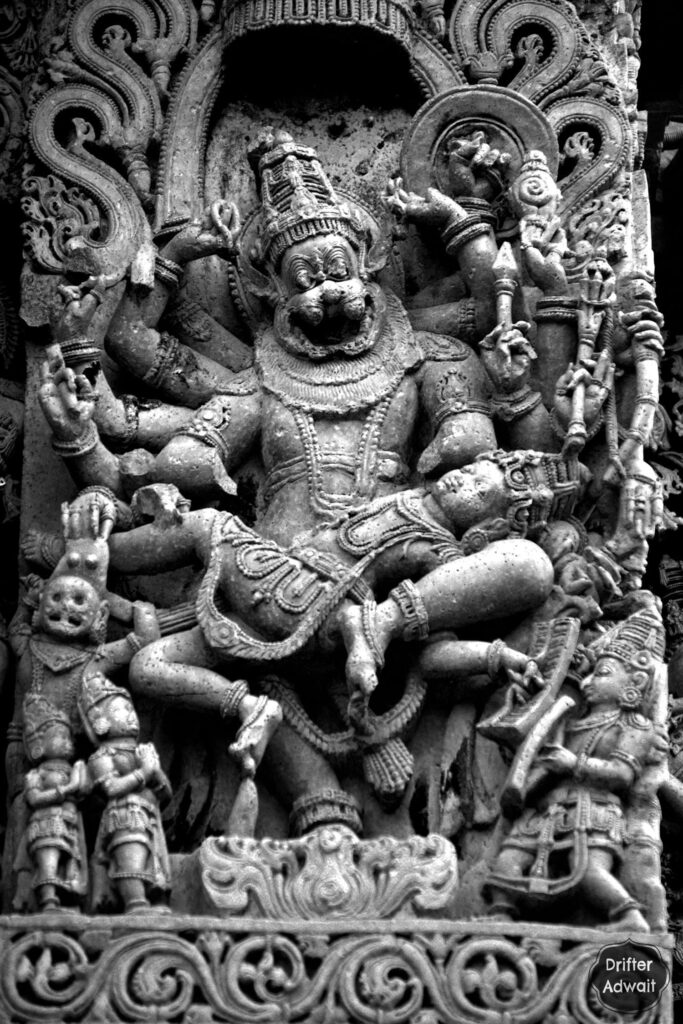
After granting the boon, Brahma returned to his celestial abode. But when Hiranyakashipu learned what had happened, anger flared within him. He rebuked the demons harshly, declaring that by abandoning him and seeking boons from Brahma they had betrayed him. Because of this he pronounced a dreadful curse.
They would be reborn within the womb of Devaki, and there they would meet their destruction at the hands of Kansa, who would appear as the form of their father Kalanemi. Thus the destiny of the Shadgarbha was sealed.
Vishnu in the Depths of Patala
जगामाथ ततो विष्णुः पातालं यत्र तेऽसुराः । षड्ङ्गर्भाः संयताः सन्ति जले गर्भगृहेशयाः ॥
संददर्श जले सुप्तान् षड्गर्भान् गर्भसंस्थितान्। निद्रया कालरूपिण्या सर्वानन्तर्हितान् स वै ॥
स्वप्नरूपेण तेषां वै विष्णुर्देहानथाविशत् । प्राणेश्वरांश्च निष्कृष्य निद्रायै प्रददौ तदा ॥
Remembering them, Vishnu descended to the depths of Patala, where the Shadgarbha lay hidden in a secret chamber beneath the waters. There they slept in deep slumber, enveloped by a mysterious sleep that seemed to possess the quiet authority of time itself. Entering their bodies in the subtle form of a dream, Vishnu gently drew forth their life-essences and entrusted them to the goddess who presides over sleep.
Shri Vishnu’s Command to the Goddess of Sleep
तां चोवाच ततो निद्रां विष्णुः सत्यपराक्रमः । गच्छ निद्रे मयोत्सृष्टा देवकीभवनान्तिकम् ॥
इमान् प्राणेश्वरान् गृह्य षड्ङ्गर्भान् दानवोत्तमान्। षड्ङ्गर्भान् देवकीगर्भे योजयस्व यथाक्रमम् ॥
जातेष्वेतेषु गर्भेषु नीतेषु च यमक्षयम् । कंसस्य विफले यत्ने देवक्याः सफले श्रमे ॥
प्रसादं ते करिष्यामि मत्प्रभावसमं भुवि। येन सर्वस्य लोकस्य देवि देवी भविष्यसि ॥
Having drawn forth the life-essences of the six ancient demons, the mighty Lord Vishnu, whose resolve never fails, addressed the goddess who presides over sleep.
He instructed her to carry those souls to the dwelling of Devaki, and there to place them, one by one, within her womb. These souls, he explained, were the powerful demons known as the Shadgarbha, and through the course of destiny they were to take birth in Devaki’s womb in the proper order.
When those children would be born and later carried away to their deaths by the cruel hand of Kansa, the tyrant’s desperate efforts to escape his fate would ultimately prove futile. At the same time, Devaki’s suffering would not be in vain, for through these events the greater design leading to the birth of Krishna would begin to unfold.
Vishnu then assured the goddess of sleep that when these events had come to pass, she would receive his special grace. Her power upon the earth, he declared, would become equal to his own influence, and she would be revered throughout the world as a divine goddess worthy of worship.
The Transfer of the Devaki’s Seventh Child
सप्तमो देवकीगर्भो योंऽशः सौम्यो ममाग्रजः । स संक्रामयितव्यस्ते सप्तमे मासि रोहिणीम् ॥
संकर्षणात्तु गर्भस्य स तु संकर्षणो युवा । भविष्यत्यग्रजो भ्राता मम शीतांशुदर्शनः ॥
In the quiet unfolding of this divine design, the Lord spoke further of the seventh child who would be conceived in Devaki’s womb. That child, he declared, would be none other than his own gentle portion—destined to appear before him in the world, and therefore to be known as his elder brother.
When that pregnancy reached its seventh month, the Lord instructed that the child should be mysteriously drawn away and transferred into the womb of Rohini, who was then living under the protection of Vasudeva’s kin.
Because this unborn child would be “drawn forth” from one womb and established in another, he would come to be known as Sankarshana—the one who is pulled or drawn away. In time he would grow into a radiant and powerful youth, his complexion serene and luminous like the cool light of the moon. Thus the one who would later be revered as Balarama, the elder brother of Krishna, first entered the world through this quiet and mysterious act within the hidden workings of divine destiny.
The Six Sons of Devaki
कृते गर्भविधाने तु देवकी देवतोपमा। जग्राह सप्त तान् गर्भान् यथावत् समुदाहृतान् ॥
षड्ङ्गर्भान् निस्सृतान् कंसस्ताञ्जघान शिलातले । आपन्नं सप्तमं गर्भ सा निनायाथ रोहिणीम् ॥
Thus, when Devaki was united with her husband Vasudeva, the radiant princess—whose beauty and grace were said to resemble that of a celestial being—conceived the children whose fate had already been woven into the fabric of destiny.
One by one the pregnancies came to term. Yet each of the first six infants met the same terrible end. Kansa, consumed by fear of the prophecy, seized each newborn child and dashed it against a stone, ending its life without mercy.
When the seventh pregnancy came, however, the course of events changed. Through the mysterious workings of Yogamaya, that unborn child was quietly transferred from Devaki’s womb into the womb of Rohini, where he would grow safely beyond the reach of Kansa’s cruelty.
That child would later be known to the world as Balarama, the elder brother of Krishna.
The Temple Sculpture in Cambodia
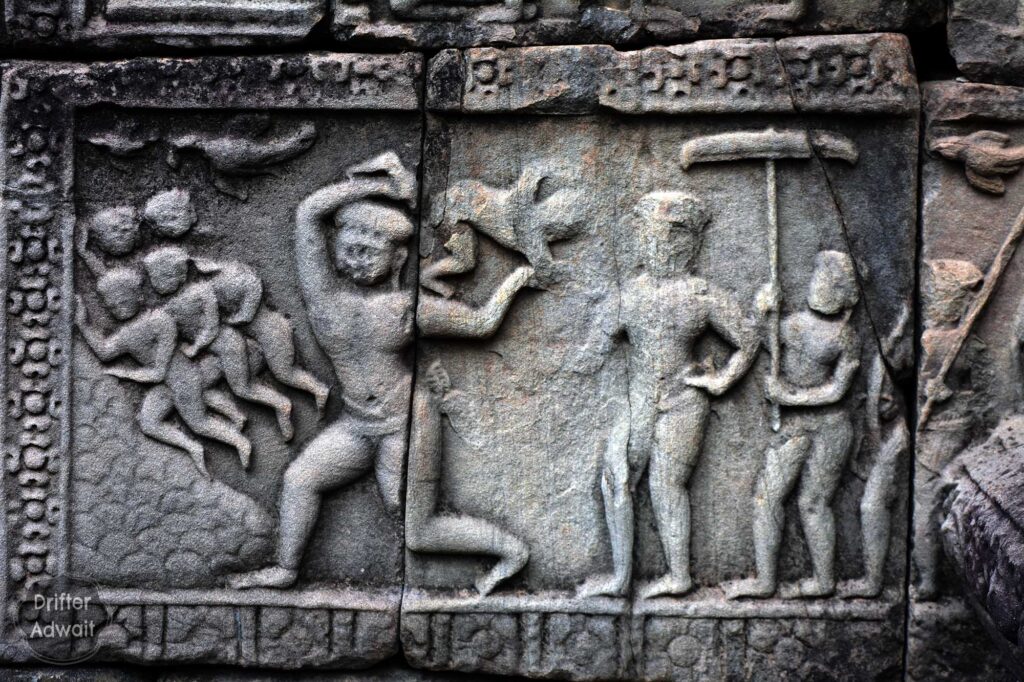
This remarkable story of prophecy, curse, and tragic destiny did not remain confined to scripture alone. It also found expression in the carved stone of a temple far from the land where the story was first told.
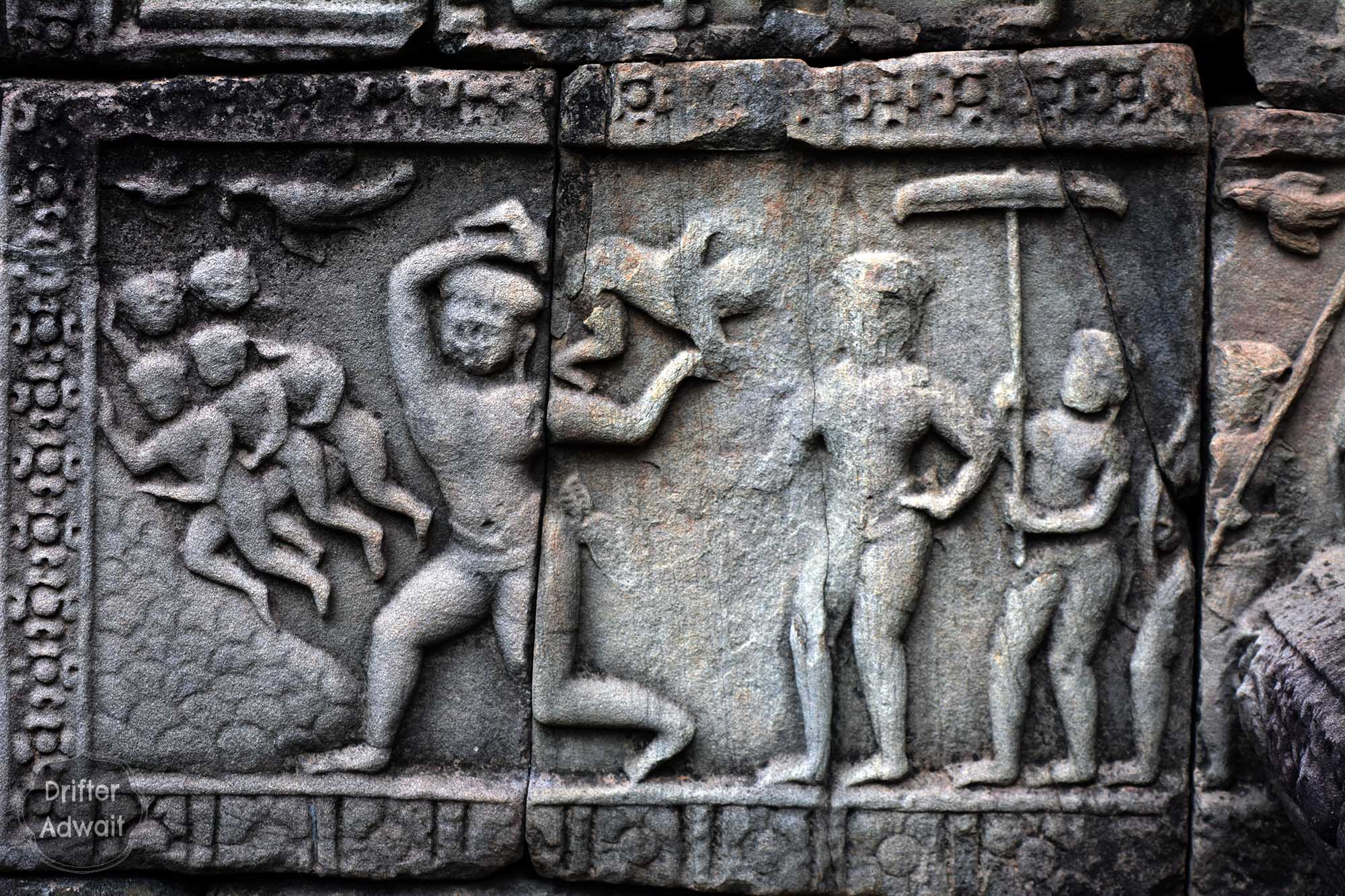
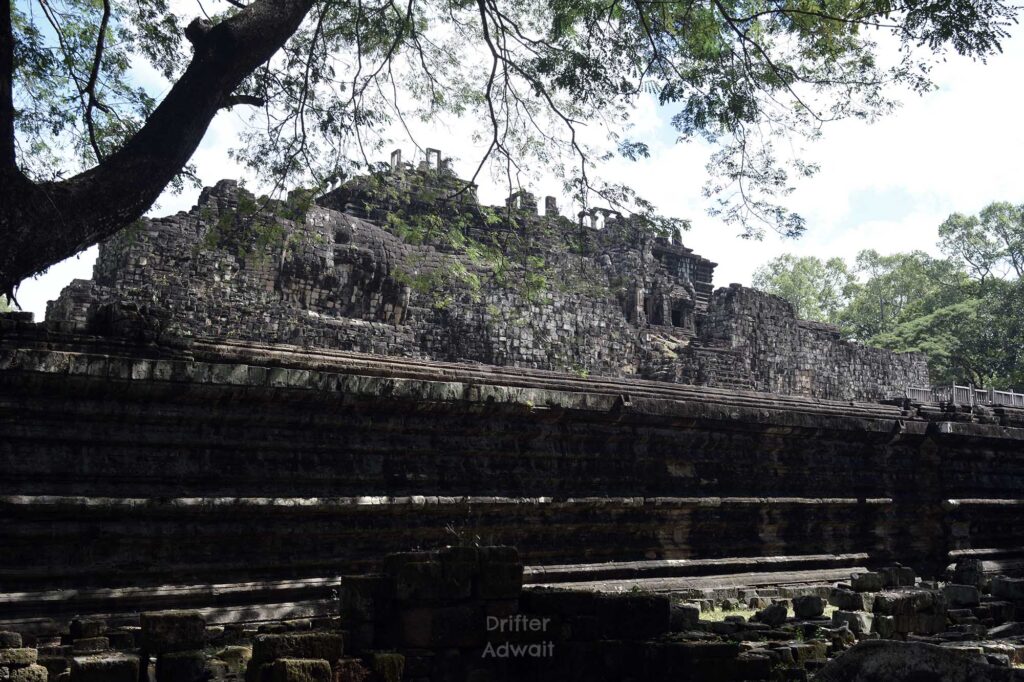
Upon the walls of a Hindu pyramid-temple once known as Swarnadri, in present-day Cambodia, stands a sculpted panel from the temple now called Baphuon. In this relief the sculptor has captured a moment of stark intensity.
Kansa is shown rushing toward Devaki’s palace after hearing of the birth of her child, his movement charged with anger and fear. Behind him stands an attendant holding the royal umbrella above his head, a sign of authority that contrasts sharply with the tyranny that drives him forward.
At the center of the panel the decisive moment unfolds. Kansa grips the helpless infant in his hands, poised to dash Devaki’s sixth son against a stone. Nearby a wall of stone appears beside five small figures, representing the children he had already slain.
Few sculptures convey such opposing emotions within a single frame. The innocence of the infants and the brutality of the tyrant are set against each other in silent contrast, preserved forever in stone.
The Birth and Transfer of Balarama in Khmer Stone
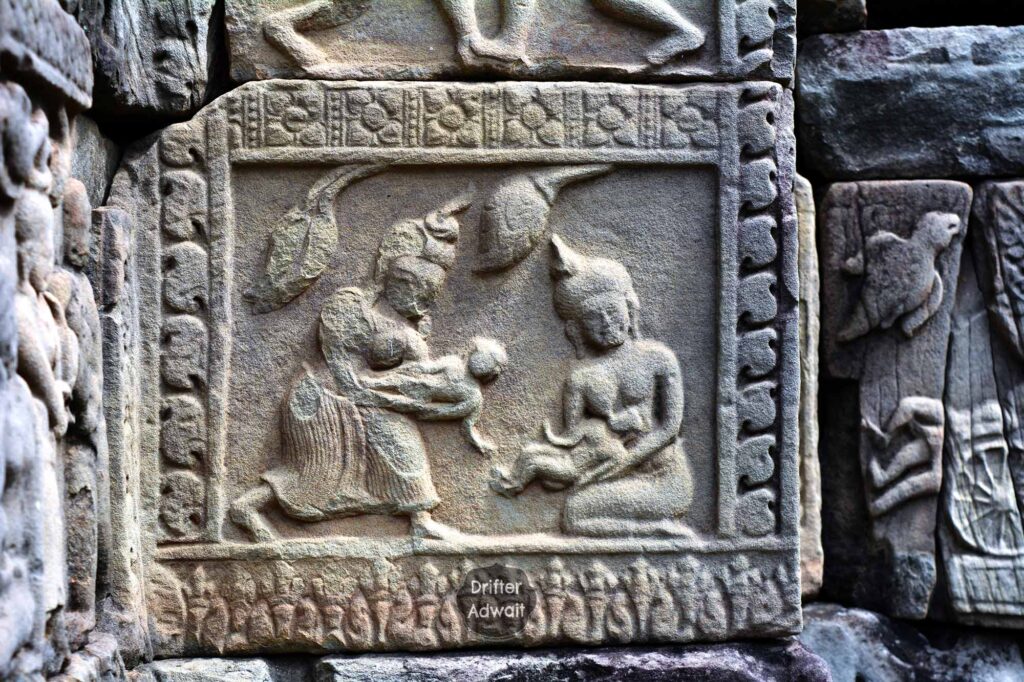
Among the carvings of Baphuon appears another scene drawn from the same sacred narrative. In this panel a female figure receives an infant while another seems to pass the child into her care.
At first glance the moment appears simple, almost domestic. Yet it reflects one of the most mysterious events described in the Puranic accounts of Krishna’s birth.
The seventh child conceived by Devaki did not share the fate of the six before him. Through the unseen power of Yogamaya, the divine energy of Vishnu, the unborn child was transferred from Devaki’s womb to that of Rohini, the second wife of Vasudeva, beyond the reach of Kansa’s watchful cruelty.
Because the child was thus drawn away from one womb and placed in another, he came to be known as Sankarshana, the one who is “drawn forth.” In time the world would know him as Balarama, the elder brother of Krishna.
The sculptor of Baphuon appears to have given visible form to this hidden moment. Some may see the female figure as Yogamaya herself, the divine power guiding the transfer of the child. Others may interpret the scene as Devaki symbolically entrusting the child to Rohini.
Whichever reading one prefers, the meaning remains the same. The sculptor sought to capture the quiet turning point in destiny, when the seventh child was placed safely beyond Kansa’s reach and the path toward Krishna’s birth was set.
How the Krishna Birth Legend Reached Baphuon
What makes this sculpture remarkable is not only the story it depicts, but the distance the story itself has traveled.
The temple of Baphuon, thousands of kilometers from India, preserves within its stone the episode of Devaki’s six sons slain by Kansa; a scene drawn from the ancient Krishna birth narrative.
The artists of the Khmer world did not choose their subjects lightly. Temple walls were reserved for stories that spoke of dharma, cosmic order, and the eventual triumph of righteousness over tyranny. That such a story appears in Cambodia reveals how deeply the epics and Puranic traditions of India shaped the spiritual imagination of Southeast Asia.
The Dharmic Meaning Behind Devaki’s Six Sons
Within the larger story of Krishna’s birth, the death of Devaki’s six sons is not merely an act of cruelty. It forms part of a deeper unfolding within the order of dharma.
The curse of the Shadgarbha had to reach its natural justified end, and through those six brief births their ancient destiny was fulfilled. At the same time the world was being prepared for the coming of Krishna, whose incarnation would restore balance in an age darkened by tyranny.
Thus the six infants were not only victims of Kansa’s fear. Their fleeting lives formed the solemn prelude to a far greater story yet to unfold.
A Khmer Tribute to India’s Sacred Stories
Perhaps it was in recognition of this deeper meaning that an unknown Khmer sculptor chose to carve this episode upon the stone walls of the temple now known as Baphuon.
Though separated from India by oceans and thousands of kilometers, the artist clearly understood the gravity of the narrative and the place it held within the larger story of Krishna’s birth.
Across seas, forests, and mountains, the stories of Krishna, the Puranas, and the wider traditions of dharma traveled with merchants, monks, scholars, and pilgrims. These narratives gradually shaped temples, kingdoms, and artistic traditions throughout Asia.
The sculpture at Baphuon stands today as a quiet testimony to that long journey. Within its carved stone survives the memory of a story that began in the sacred imagination of India, yet found a place thousands of kilometers away in the temples of another land.
Reference:
Primary Texts
1.Shri Harivansh Puran. Harivansha Parva, Adhyay 48–55. Gorakhpur: Gita Press, First Edition.
2.Shri Harivansh Puran. Vishnu Parva, Adhyay 1–4. Gorakhpur: Gita Press, First Edition.
Temple / Sculptural Evidence
1.Relief sculptures depicting the Kansa–Devaki–Krishna birth narrative, Baphuon Temple (ancient Swarnadri), Angkor region, Cambodia.
2.Relief panels related to Krishna and associated Vaishnava narratives, Banteay Srei Temple, Angkor region, Cambodia.
3.Sculpture of Balarama (Sankarshana), National Museum of Cambodia (Archaeological Museum), Phnom Penh.
4.Sculpture of Balarama, Lakshmi Narasimha Temple, Javagal, Karnataka, India.