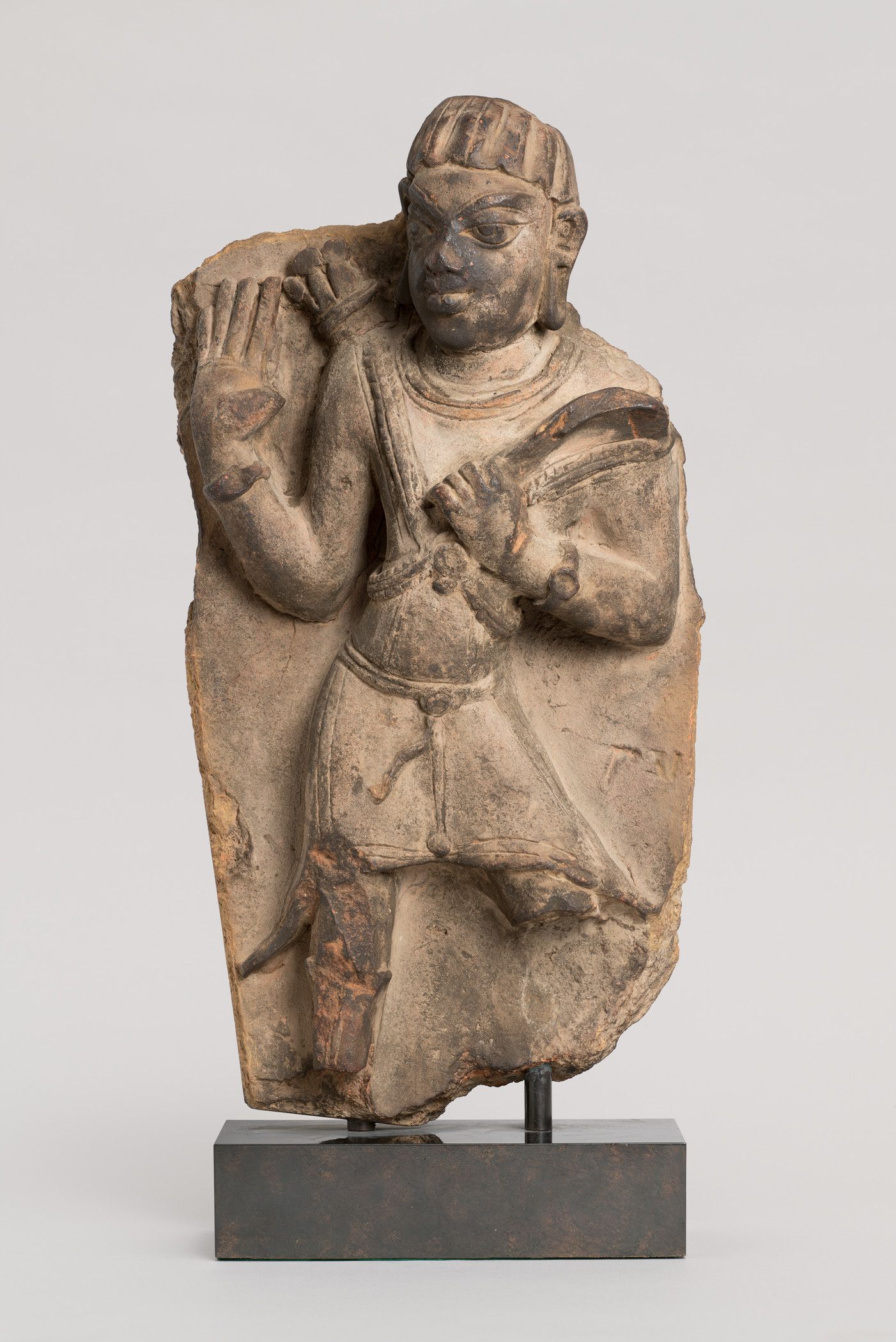
The oldest sculpture of Shri Rama dates to the 3rd–4th century CE and was discovered in Haryana, India. This terracotta figure is identified by a Brahmi inscription reading “𑀭𑀸 𑀫” (Rā Ma) beneath the arm, making it the earliest definitive representation of Shri Rama known to history.
How old is the story of Shri Rama?
In India, the answer is rarely given in dates. It lives in memory, in recitation, in quiet habits of thought. But sometimes, the earth itself offers an answer—something small, material, and impossible to argue with.
One such answer comes to us from a terracotta figure discovered in Haryana.
It does not speak loudly.
It simply bears a name.
Dated to around the 3rd–4th century CE, this terracotta sculpture—now preserved at LACMA—is widely regarded by scholars as the earliest known definitive sculpture of Shri Rama.
At first glance, the figure is that of a warrior.
He stands upright, holding a bow. A quiver rests behind him. Across his chest runs the channavira, the cross-belt of a Kshatriya. His right hand is raised in abhaya mudra—a gesture of reassurance, of protection.
His expression is composed. The eyes are large, attentive. There is a quiet smile—not of triumph, but of inner steadiness.
But the true certainty lies in a small detail.
Brahmi Inscription: “𑀭𑀸 𑀫” — The Earliest Naming of Shri Rama
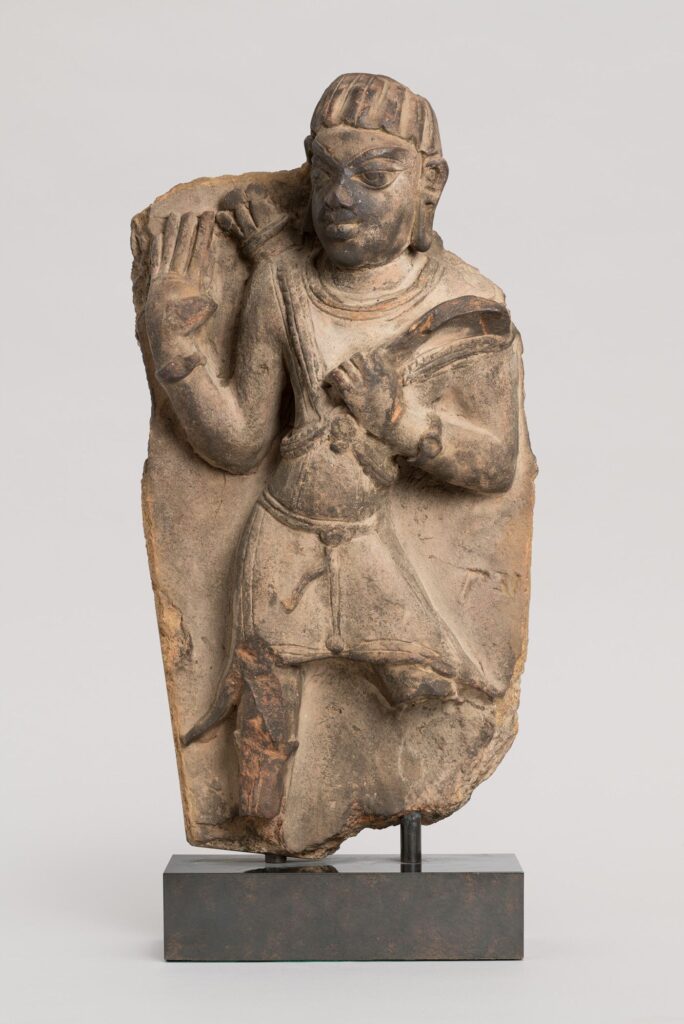
Just below the left arm of the figure, in late Brahmi script, two syllables are inscribed:
Brahmi:
𑀭𑀸 𑀫
Devanagari:
रा म
English Transliteration:
Rā Ma (Shri Rama)
These two syllables transform the sculpture.
Without them, it might have remained an anonymous warrior. With them, it becomes something precise, anchored. Shri Rama, named and remembered over 1600 years ago. There is something deeply human in this act. The sculptor did not rely on symbolism alone. He ensured recognition.
He wrote the name.
Iconography: How Shri Rama is Depicted in the Oldest Sculpture
This sculpture also tells us how Shri Rama was understood in that period.
He is not yet the heavily ornamented, fully divine icon of later centuries. He appears closer, almost within reach. His attire resembles that seen on Gupta-period royal coins. The tunic, the bearing, even the stylised headgear echo the imagery of kings.
This is not coincidence.
In early historic India, Shri Rama was not only worshipped—he was a standard.
Kings were compared to him. In inscriptions, rulers are described as:
“राम तुल्यो धर्मपरतया”
(Rāma tulyo dharma-paratayā)
“Equal to Shri Rama in righteousness.”
Here, Shri Rama is not distant divinity. He is the measure of dharma, of conduct, of kingship itself.
Nacharkheda Terracottas: Sita and Lakshmana in Exile
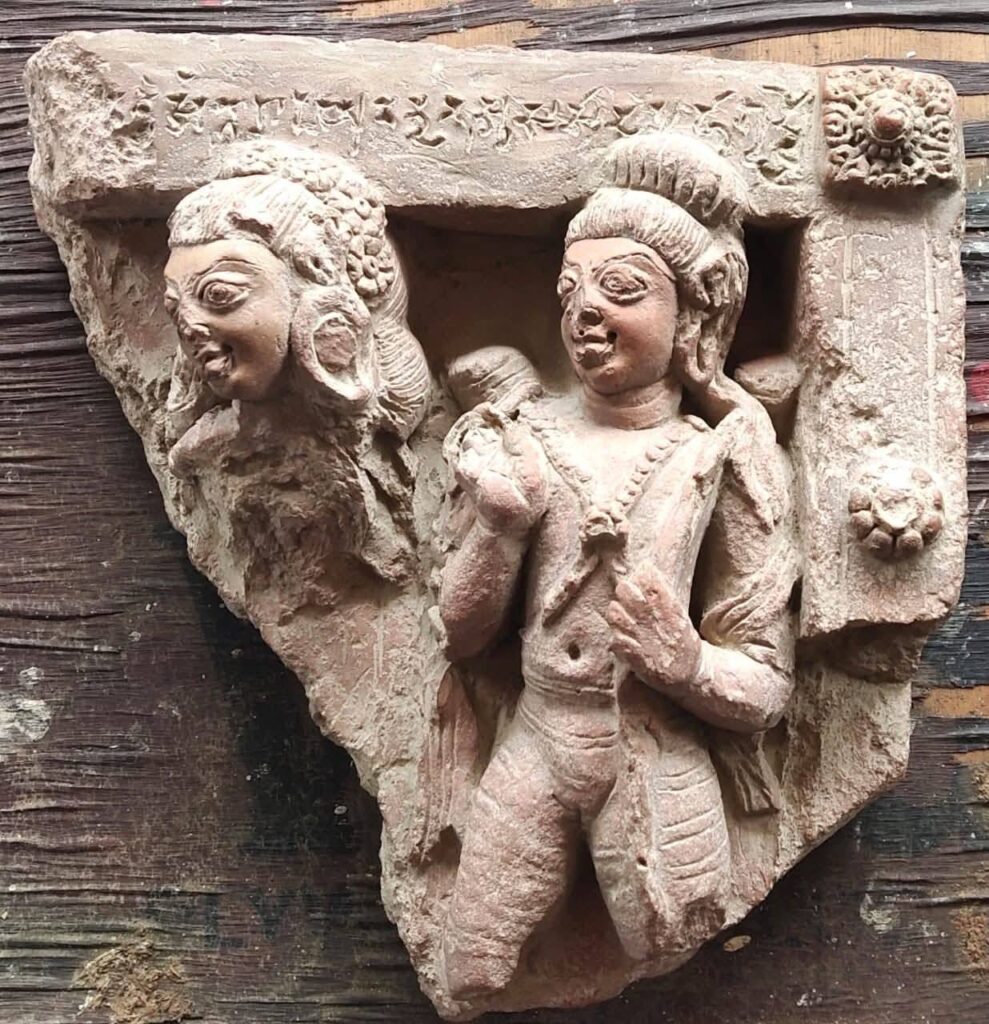
From the same region: Nacharkheda in Haryana. Another set of terracotta panels, dated to the 5th century CE, offers a different kind of presence.
One fragment shows Sita and Lakshmana walking into the forest during exile. Shri Rama himself is missing, the panel is broken; but his absence is almost tangible. He would have been just ahead.
Lakshmana appears as a young warrior: A jata tied atop his head, a channavira across his chest, a bow resting on his shoulder, and a quiver at his back.
Sita walks beside him, her hair adorned with flowers, her expression gentle and composed.
And what stands out is this:
They are not depicted in despair. They have lost their kingdom. They walk into uncertainty.
And yet, their faces carry a quiet dignity, an inward steadiness.
Not suffering displayed.
But character revealed.
Ramayana Verse in Brahmi, Devanagari and English
On this same panel, carved into the clay, is a line from the Valmiki Ramayana (Aranyakanda, Sarga 14)—marking the moment when Shri Rama meets Jatayu.
Here it is, preserved across time:
Brahmi (as inscribed)
𑀦𑁆𑀦𑀦𑁆𑀢𑀭𑀸 𑀭𑀖𑀼𑀦𑀦𑁆𑀤𑀦ः …
𑀆𑀲𑀲𑀸𑀤 𑀫𑀳𑀸 … 𑀕𑀾𑀥𑁆𑀭𑀁 …
Devanagari (standard Sanskrit)
अथ पञ्चवटीं गच्छन्नन्तरा रघुनन्दनः।
आससाद महाकायं गृध्रं भीमपराक्रमम्॥
English Transliteration
Atha Pañcavaṭīṁ gacchan antarā Raghunandanaḥ,
Āsasāda mahākāyaṁ gṛdhraṁ bhīma-parākramam.
Meaning: While proceeding towards Panchavati, Shri Rama—the delight of the Raghu lineage—encountered a विशाल (mighty) vulture of immense strength: Jatayu.
Ramayana in Sculpture: Text and Image Together in Early India
Pause for a moment and consider what this represents in the context of early Indian art and the Ramayana tradition. Around 1500 years ago, an artist did not simply depict a scene from the Ramayana. He chose to anchor it with the original verse itself, inscribed alongside the image. In doing so, the sculpture moves beyond representation. It does not merely show; it speaks.
The presence of the inscribed verse transforms the act of viewing. The observer does not merely see the scene, but he recalls it, almost as if the text and image together are guiding memory. This union of visual form and sacred narrative is what gives such works their lasting power. It is also what makes discoveries like the Nacharkheda panels so significant in understanding the spread of the epic.
For anyone studying the oldest sculpture of Shri Rama and early Ramayana depictions, this becomes an important insight: the Ramayana was never confined to manuscripts or oral recitation alone. It lived simultaneously in multiple forms: spoken, written, and sculpted. Temple walls, terracotta panels, and inscribed verses together created a shared cultural space where the story of Shri Rama was not just told, but continuously experienced.
What This Reveals About Early Ramayana Tradition
Taken together, these findings tell us something clear and difficult to ignore:
-By the 3rd–4th century CE, Shri Rama was already a clearly recognized figure.
-His identity was stable enough to be named in inscription.
-By the 5th century, his story was being narrated visually, alongside textual quotations.
-The Ramayana was not emerging—it was already deeply rooted
This is not the beginning of the tradition.
This is continuity already in motion.
Shri Rama Across Time: Why the Ramayana Still Feels Relevant
There is a certain stillness in these sculptures. Something that does not demand attention, and yet quietly holds it. They do not argue, they do not proclaim, and they make no effort to convince. And still, they endure. The oldest sculpture of Shri Rama, shaped in simple terracotta over 1600 years ago, does something remarkable. It bridges time without appearing to try.
The Shri Rama who stands in that figure does not feel distant or unreachable. He is not lost to history. In much the same way, the Sita and Lakshmana walking into exile in the Nacharkheda panels do not feel like figures from a vanished age. Their expressions, their composure, their quiet dignity; these remain recognisable even today.
Perhaps that is the deeper reason the Ramayana has endured across centuries. Not merely because it was preserved, but because it continued to feel familiar. Something in these forms, whether in clay, in verse, or in memory has always remained close to lived human experience.
As Long as Rivers and Mountains Endure
Maharshi Valmiki, in a moment of striking clarity, expressed this continuity in words that have themselves travelled across millennia:
Devanagari
यावत् स्थास्यन्ति गिरयः सरितश्च महीतले। तावद् रामायणकथा लोकेषु प्रचरिष्यति॥
English Transliteration
Yāvat sthāsyanti girayaḥ saritaś ca mahītale,
Tāvad Rāmāyaṇa-kathā lokeṣu pracariṣyati.
Meaning
As long as mountains stand and rivers flow upon the earth, the story of Shri Rama will continue to be told.
When read today, these lines may appear poetic—almost prophetic. But when placed alongside the oldest known sculpture of Shri Rama and the inscribed Ramayana panels from Haryana, they feel less like a prediction and more like a simple observation of cultural truth. The story was already alive then, just as it is now—moving across generations, finding new forms, yet remaining essentially unchanged.
Conclusion: Why This Is the Oldest Known Sculpture of Shri Rama
The oldest known sculpture of Shri Rama, marked with the Brahmi inscription 𑀭𑀸 𑀫, does not seek grandeur or spectacle. It does not present itself as a monument meant to impress. Instead, it offers something quieter, and in many ways, more enduring.
It tells us that over 1600 years ago, someone shaped this figure with care, and then paused—just long enough to inscribe a name. Not a title, not a declaration, just “Rā Ma.” A small act, almost understated, but one that ensured recognition across centuries.
And that is perhaps the most remarkable part.
It was not forgotten.
References:
- Connected Histories of India and Southeast Asia, ed. Parul Pandya Dhar (2023)
- LACMA Research Archives
- Pic 1: Courtesy: LCMA
Pic 2: Courtesy: Gurukul Museum Jhajjar.