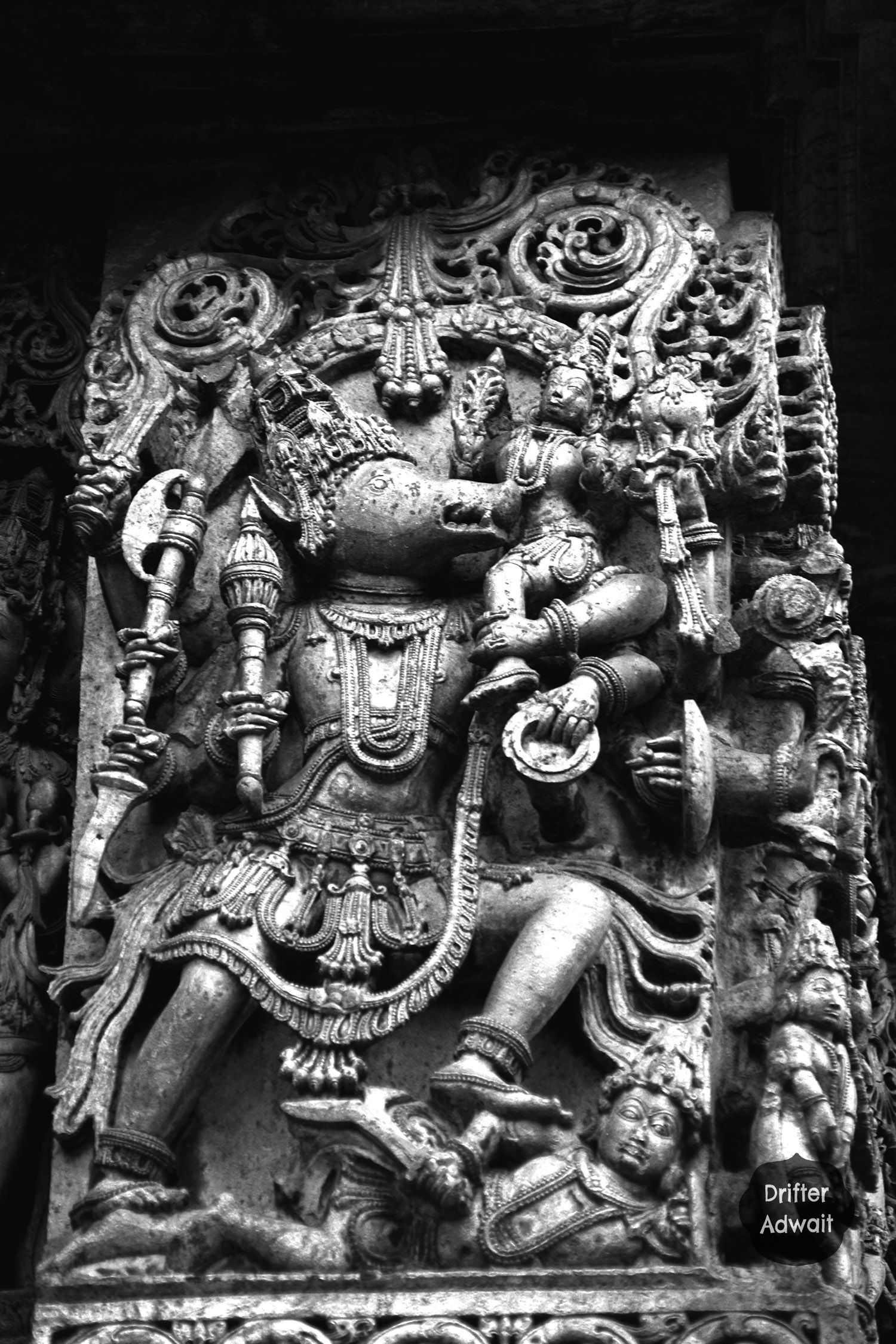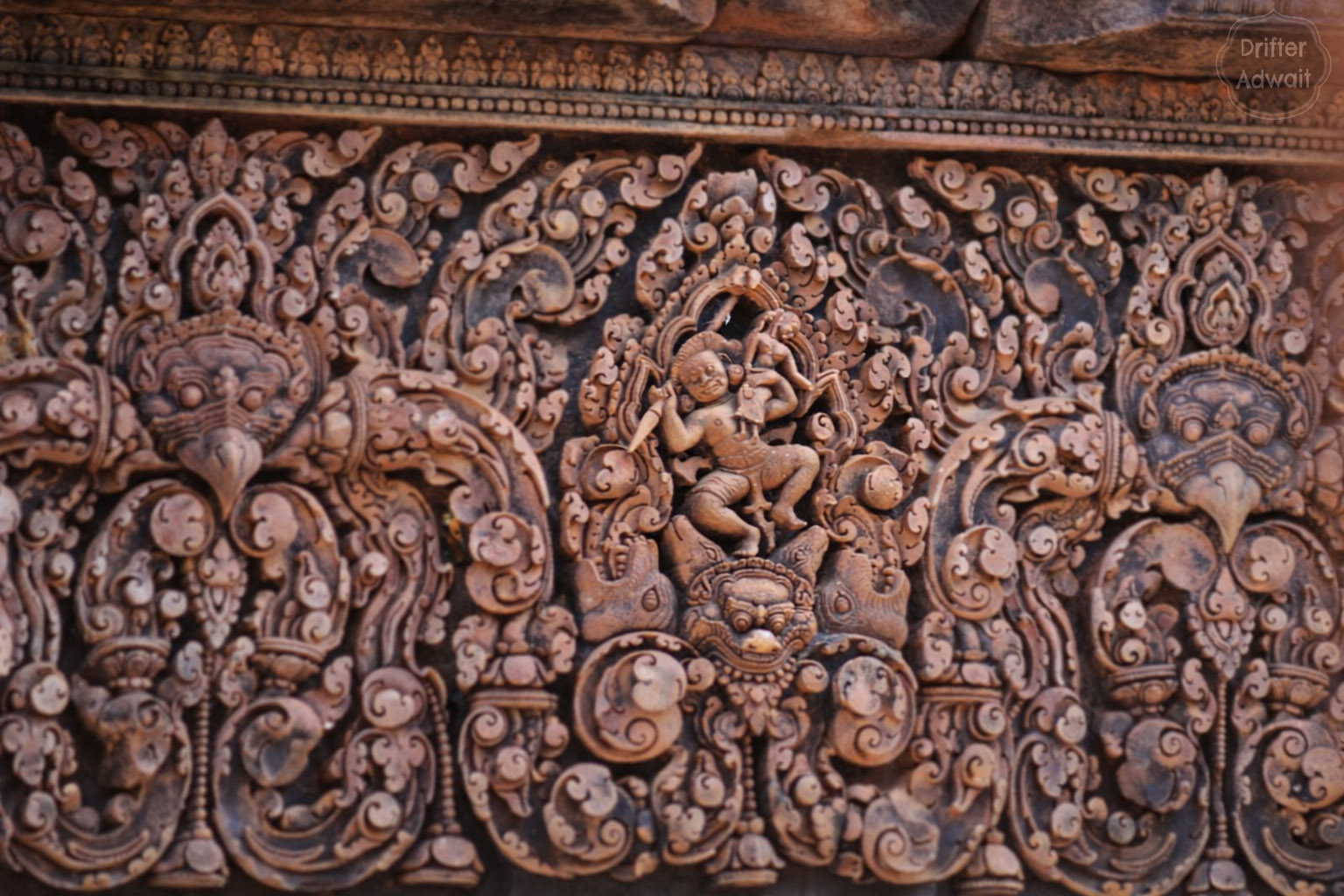

In the Valmiki Ramayana, the encounter with Viradha was one of the earliest and most meaningful episodes in the Aranyakanda, the forest section of the epic. This episode involved the rakshasa Viradha abducting Sita during the forest exile of Shri Rama and Lakshmana. The narrative was significant not only for its place in the story but also for its deeper cultural symbolism and its artistic representation beyond India.
The episode prefigured later events in the Ramayana, such as the abduction of Sita by Ravana, and was depicted in sculpture and performance traditions across Greater India and in Southeast Asia, including Cambodia. Viradha’s presence in both text and art demonstrated how the Ramayana influenced societies across cultures and centuries.
Setting the Scene: Early Days of Forest Exile

The story of Viradha began during the early days of the forest exile of Shri Rama, Lakshmana, and Sita. In Ramayana, this is when the Aranyakanda begins. After departing from the hermitage of the sages where they had spent the night, Shri Rama took leave of the sages at sunrise before entering deeper into the Dandaka forest. The landscape they entered was described as disturbed; the natural environment was damaged, water sources were rare, and animals and birds filled the space with sound.
नानामृगगणाकीर्णमृक्षशार्दूलसेवितम् । ध्वस्तवृक्षलतागुल्मं दुर्दर्शसलिलाशयम् ॥
निष्कूजमानशकुनिं झिल्लिकागणनादितम् । लक्ष्मणानुचरो रामो वनमध्यं ददर्श ह ॥
सीतया सह काकुत्स्थस्तस्मिन् घोरमृगायुते । ददर्श गिरिशृङ्गाभं पुरुषादं महास्वनम् ॥
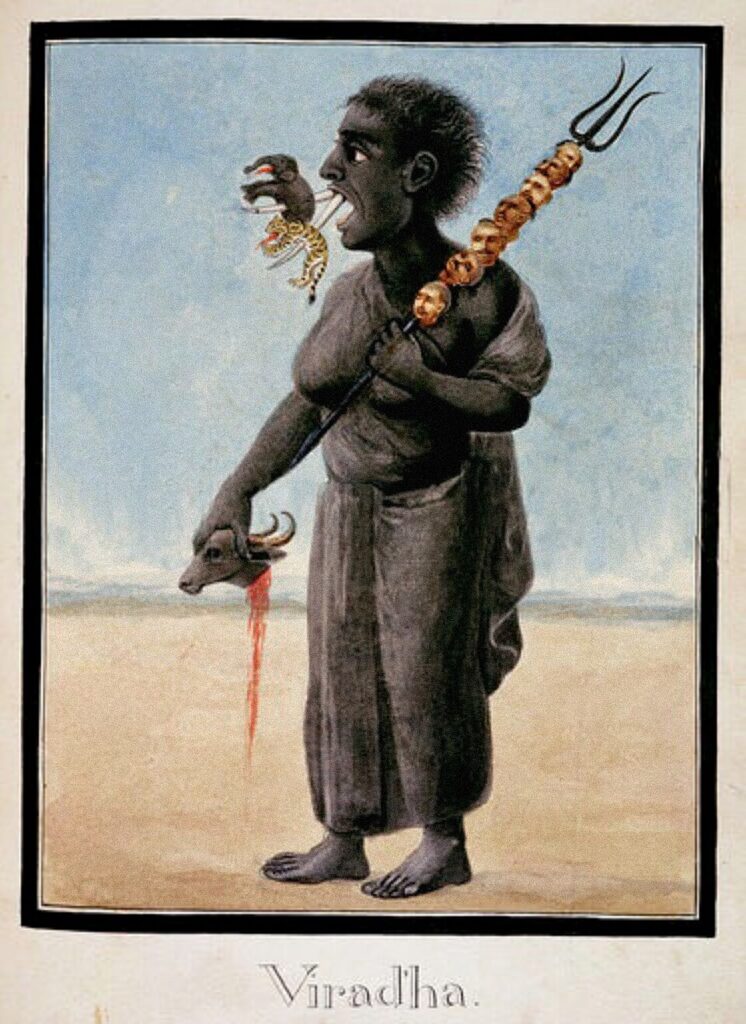
As they went on, Rama and Lakshmana reached a deep part of the forest teeming with many kinds of deer. Bears and tigers also dwelled there. The trees, vines, and bushes were broken and ravaged, and water was scarce in that region. Birds chirped while the sound of crickets echoed all around. In that impenetrable forest, crowded with fierce wild beasts, Rama, with Sita by his side, beheld a man-eating demon—towering like a mountain peak and roaring fiercely.
गभीराक्षं महावक्त्रं विकटं विकटोदरम् । बीभत्सं विषमं दीर्घ विकृतं घोरदर्शनम् ॥
वसानं चर्म वैयाघ्रं वसार्द्र रुधिरोक्षितम् । त्रासनं सर्वभूतानां व्यादितास्यमिवान्तकम् ॥
त्रीन् सिंहांश्चतुरो व्याघ्रान् द्वौ वृकौ पृषतान् दश । सविषाणं वसादिग्धं गजस्य च शिरो महत् ॥
अचसज्यायसे शूले विनदन्तं महास्वनम् ।
His eyes were deep-set, his mouth vast, his shape monstrous, and his belly immense. Terrible to behold, misshapen and colossal, he wore a hideous guise. A tiger’s skin, soaked in blood and slick with fat, hung about his body. This tormentor of all creatures stood there with jaws stretched wide, like Death himself made manifest.
Upon an iron spear he had impaled his grim trophies—three lions, four tigers, two wolves, ten spotted deer, and the severed head of a great elephant, tusks unbroken and smeared with grease—and he roared aloud. At the sight of Rama, Lakshmana, and Princess Sita, rage flared within him. He gave a fearsome cry that shook the ground and rushed upon them, as the god of death might advance to meet his doom-bound prey.
अड्ड्रेनादाय वैदेहीमपक्रम्य तदाब्रवीत् । युवां जटाचीरधरौ सभार्यों क्षीणजीवितौ ॥
प्रविष्टौ दण्डकारण्यं शरचापासिपाणिनौ ।
He lifted Sita, daughter of Videha, onto his lap and lingered at a distance. Then he spoke to the two brothers, his voice dark and mocking: “You, who wear matted hair and the garments of ascetics, yet dwell with a woman and wander the Dandaka forest with bow, arrow, and sword in hand—your lives seem near their end. You appear as holy men, yet live with a young woman. Who are you, wicked and sinful, a stain upon the community of sages?”
“I am Viradha, a demon who prowls this impenetrable forest,” he declared, “armed and fierce, feasting daily upon the flesh of sages.”
इयं नारी वरारोहा मम भार्या भविष्यति ॥ युवयोः पापयोश्चाहं पास्यामि रुधिरं मृधे ।
‘This woman is very beautiful, therefore she will become my wife, and I will drink the blood of you two sinners on the battlefield.’
Shri Rama and Lakshmana Confront Viradha
Hearing the wicked and arrogant words of Viradha, Sita, daughter of Janaka, was stricken with terror. She trembled uncontrollably, like a banana tree lashed by a sudden storm. Seeing the virtuous Sita caught in the demon’s grasp, Rama’s mouth dry with dread, spoke to Lakshmana:
“O gentle one! Behold—King Janaka’s daughter, my chaste and noble wife, has been seized by Viradha. This is the fate of the illustrious princess, raised in comfort and care! Alas, what a grievous misfortune! Lakshmana, the hardships Kaikeyi wished upon us, all that she coveted and sought by her boons, have come upon us this very day.”
At Rama’s words, Lakshmana’s anger blazed, and he hissed like a serpent bound by enchantment:
“O jewel of the Kakutstha line! You are like Indra, protector of all beings. Why grieve as an orphan while I, your servant, stand by your side? Now, in my wrath, I shall strike down this demon. Today, the earth shall drink the blood of Viradha, felled by my hand. The anger I once bore against Bharata for the kingdom, I now unleash upon him—just as Indra, wielder of the thunderbolt, rends the mountains with his fury.”
Viradha, his voice shaking the forest, bellowed:
“Hey! Tell me—who are you two, and whither are you bound?”
Rama, resplendent and calm before the fearsome demon, replied:
“Know this: I belong to the line of King Ikshvaku. We are Kshatriyas, sons of valor, who uphold righteousness. For a purpose, we dwell in this forest. Now tell us, who are you, who prowls the Dandaka wilds?”
Viradha’s Boon and Invincibility
Hearing Rama’s words, Viradha laughed grimly and said:
“O king of the Raghu line! I shall gladly tell you who I am. Listen well to the tale of Viradha.”
पुत्रः किल जवस्याहं माता मम शतहृदा । विराध इति मामाहुः पृथिव्यां सर्वराक्षसाः ॥
तपसा चाभिसम्प्राप्ता ब्रह्मणो हि प्रसादजा । शस्त्रेणावध्यता लोकेऽच्छेद्याभेद्यत्वमेव च ॥
“I am the son of the demon Java, born of my mother Shatahda. Among all the demons of this world, I am known as Viradha. Through long and grievous penance, I won the favor of Lord Brahma and was granted this boon: no weapon may slay me. In this world I stand invincible and unassailable—no blade can cleave my body, nor strength tear me apart.”
Battle Between Rama, Lakshmana, and Viradha

“Now, leave this young woman here and depart at once, as you came, with no thought of taking her. I will not take your lives.”
At these words, Lord Rama’s eyes blazed with anger. He drew his bow and loosed a volley of arrows at the demon. Seven sharp shafts, swifter than Garuda in flight and the rushing wind, tipped with golden feathers, streaked like flames toward Viradha. They struck him true, piercing his monstrous body, staining the arrows with blood as they fell to the ground. Wounded, the demon released Sita, princess of Videha, and snatching up a spear, charged furiously at Rama and Lakshmana.
He roared, brandishing a trident that gleamed like Indra’s own weapon, mouth wide as Death itself. The two brothers rained down a storm of blazing arrows upon the fearsome Viradha, who seemed Time incarnate, Yama himself made flesh.
The demon, laughing with grim defiance, stretched and yawned—and as he did, the arrows embedded in his body tumbled to the ground.
Protected by his boon, Viradha recovered, seizing his spear once more and hurling himself at the Raghuvanshi heroes. The spear blazed across the sky like a thunderbolt wreathed in fire. Yet Shri Ramchandra, peerless with weapons, struck it down with two arrows. The shattered spear fell to the earth like a fragment of Mount Meru split by the thunderbolt of heaven.
तौ खड्गौ क्षिप्रमुद्यम्य कृष्णसर्पाविवोद्यतौ । तूर्णमापेततुस्तस्य तदा प्रहरतां बलात् ॥
स वध्यमानः सुभृशं भुजाभ्यां परिगृह्य तौ । अप्रकम्प्यौ नरव्याघ्घ्रौ रौद्रः प्रस्थातुमैच्छत ॥
The two brothers, each brandishing a sword as black and sinuous as a serpent, lunged at him, striking with relentless force. Wounded grievously by their blows, the fearsome demon seized the two steadfast, lion-hearted warriors in his massive arms and sought to carry them away.
The Strategy to Overcome Viradha
Understanding the demon’s intent, Rama spoke to Lakshmana:
“Son of Sumitra, let this demon carry us where he will. Let him be our vehicle; there is no need to resist. The path he takes this night is the very path we must follow.”
Arrogant in his mighty strength, Viradha lifted the two brothers like mere children, placing them upon his shoulders. With a fearsome roar, he set off deeper into the forest.
He entered a wood as dense and dark as a mass of storm-laden clouds, filled with towering trees. Strange beauty lay in the flocks of birds that moved among the branches, while jackals and ferocious beasts prowled through the shadows below.
Seeing the demon bearing away Rama and Lakshmana—the jewels of the Kakutstha line—Sita lifted her arms in despair, crying aloud:
“Alas! This fierce demon carries away Rama and Lakshmana, sons of Dasharatha, truthful, virtuous, and pure in thought and deed! O chief of demons, I beg you—take me instead! Let the bears, tigers, and leopards of this forest devour me, but release these heroes of the Kakutstha dynasty!”
At the sound of Sita’s anguished cries, the two brothers, Rama and Lakshmana, hastened to strike down the wicked demon with renewed fury.
Defeating the Invincible Demon
तस्य रौद्रस्य सौमित्रिः सव्यं बाहुं बभञ्ज ह । रामस्तु दक्षिणं बाहुं तरसा तस्य रक्षसः ॥
स भग्नबाहुः संविग्नः पपाताशु विमूर्च्छितः । धरण्यां मेघसंकाशो वज्रभिन्न इवाचलः ॥
मुष्टिभिर्बाहुभिः पद्भिः सूदयन्तौ तु राक्षसम् । उद्यम्योद्यम्य चाप्येनं स्थण्डिले निष्पिपेषतुः ॥
Sumitra’s son, Lakshmana, struck with fierce precision and broke the demon’s left arm, while Shri Rama shattered his right with tremendous force. With both arms broken, the cloud-dark demon writhed in pain, then collapsed, falling to the ground like a mountain cleft by a thunderbolt. Seizing the moment, Rama and Lakshmana rained blows upon Viradha with fists, arms, and powerful kicks. They lifted him, hurled him down, and dragged him across the forest floor, relentless in their assault.
Though the demon had been pierced by countless arrows, cut by swords, and dragged across the forest floor, he still did not die. Seeing Viradha, immovable and as unyielding as a mountain, Lord Rama—grantor of fearlessness in times of peril—spoke to Lakshmana:
“O lion among men! This demon has grown invincible through penance and the boon he received. No weapon can fell him in battle. We must now dig a pit and bury Viradha to overcome him.”
“Lakshmana, dig a deep and mighty pit in this forest for this demon, as formidable as an elephant and possessed of terrible strength.”
Obeying the command, Lakshmana began to dig, while the mighty Rama stood with one foot pressing firmly upon Viradha’s neck. Humbled before the best of men, the demon Viradha bowed and spoke to Lord Ramachandra, acknowledging his superiority.
Viradha’s True Identity Revealed
हतोऽहं पुरुषव्याघ्र शक्रतुल्यबलेन वै । मया तु पूर्व त्वं मोहान्न ज्ञातः पुरुषर्षभ ॥
कौसल्या सुप्रजास्तात रामस्त्वं विदितो मया। वैदेही च महाभागा लक्ष्मणश्च महायशाः ॥
“O lion among men! O best of men! Your strength rivals that of Indra, the king of the gods. By your hand, I have been slain. In my delusion, I failed to recognize you before. Through you, Mother Kausalya is blessed with a son truly worthy. Now I see that you are indeed Shri Ramachandra. This virtuous lady is Sita, daughter of the king of Videha, and this is your younger brother, the renowned Lakshmana.”
अभिशापादहं घोरां प्रविष्टो राक्षसीं तनुम् । तुम्बुरुर्नाम गन्धर्वः शप्तो वैश्रवणेन हि ॥
प्रसाद्यमानश्च मया सोऽब्रवीन्मां महायशाः । यदा दाशरथी रामस्त्वां वधिष्यति संयुगे ॥
तदा प्रकृतिमापन्नो भवान् स्वर्ग गमिष्यति ।
“I was compelled to take this hideous demonic form because of a curse. I am Tumburu, a Gandharva by birth. Kubera himself cursed me to become a demon. When I sought to appease him, the illustrious Kubera spoke these words to me: ‘Gandharva! When Rama, son of Dasharatha, strikes you down in battle, you shall regain your true form and ascend once more to heaven.’”
अनुपस्थीयमानो मां स क्रुद्धो व्याजहार ह ॥ १८ ॥ इति वैश्रवणो राजा रम्भासक्तमुवाच ह ।
तव प्रसादान्मुक्तोऽहमभिशापात् सुदारुणात् ॥ भुवनं स्वं गमिष्यामि स्वस्ति योऽस्तु परंतप ।
I was infatuated with the Apsara named Rambha, and one day I failed to present myself for her service at the appointed time. Enraged by this, King Vaishravana (Kubera) pronounced the curse upon me and specified its duration. O Raghuvira, tormentor of enemies! Today, by your grace, I have been freed from that terrible curse. May you be blessed! Now I shall return to my own realm.
O Rama! Bury my body in a pit and depart safely. Burying the bodies of slain demons in a pit is their eternal custom, and those who are thus interred attain the eternal realms.
Having spoken these words to Rama, the mighty Viradha, pierced by arrows and placed in the pit, relinquished his body and ascended to heaven.
Thus, having defeated the demon, Rama, accompanied by Sita, princess of Mithila, and bearing his magnificent golden bow, roamed joyfully through the great forest with Lakshmana, like the sun and moon shining together in the sky.
Artistic Representation in Cambodia


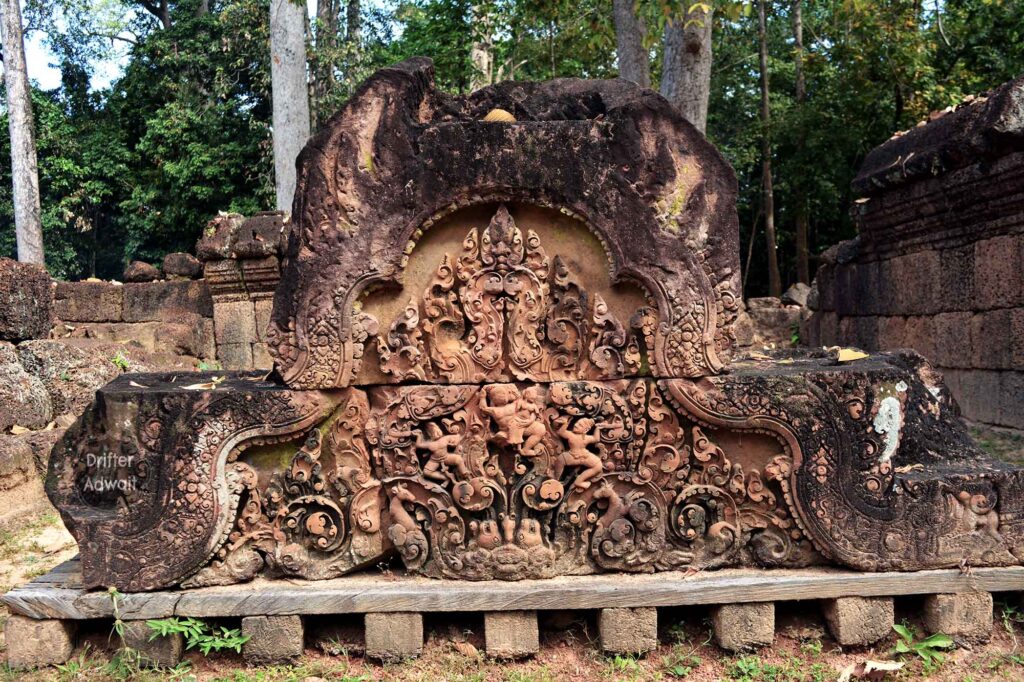
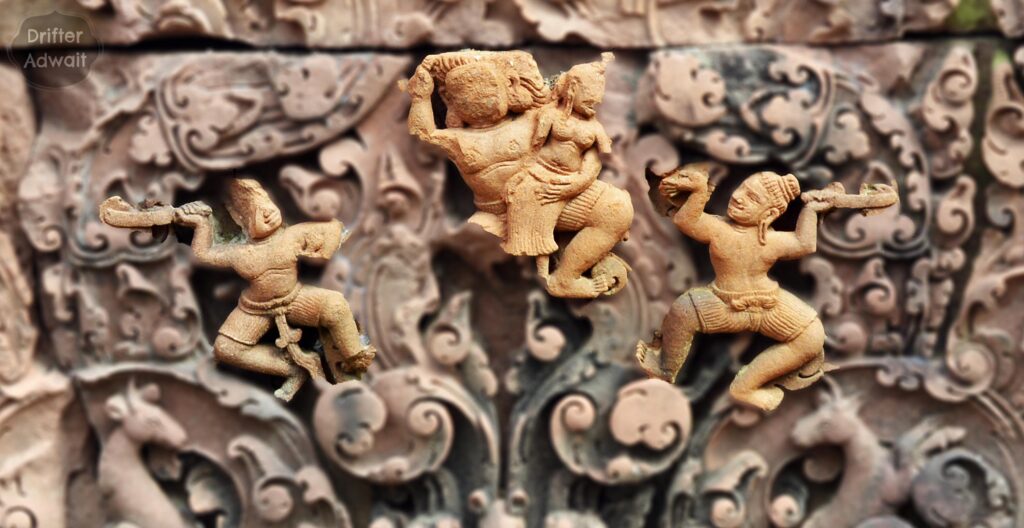
The episode of Viradha’s abduction of Sita, though less familiar to many readers, marks the first armed confrontation between Shri Rama and the rakshasas during his forest exile. It foreshadows the greater conflicts of the Ramayana, combining valor, moral tension, and forewarning. This episode was given an exceptionally refined visual expression at the temple of Tribhuvanamaheshvara, later known as Banteay Srei, on a highly intricate torana where the narrative was carved with remarkable clarity.
At the center, Viradha dominates, carrying Sita aloft with immense strength. His massive, muscular form, bent knees, and raised arms convey effort and menace, while his partially damaged face emphasizes his monstrous nature. Clad in a Khmer-style sampot dhoti with detailed folds and traces of ornamentation, he appears both terrifying and semi-divine. Sita, seated gracefully on his shoulder, contrasts with his aggression through her composed posture and elegant drapery, one hand lifted in appeal. Rama and Lakshmana flank them, mid-leap with swords raised, embodying controlled heroism and dynamic motion.
The scene’s energy is enhanced by diagonal lines formed by Viradha’s trident, the brothers’ swords, and Sita’s pose, while swirling floral and foliate motifs frame the figures. Despite the stone medium, the carving conveys vivid drama: Viradha’s aggression, the brothers’ disciplined valor, and Sita’s dignified distress. The sculptor captured physical mass, movement, and emotion with remarkable realism, immortalizing this episode across time. Experiencing the torana in person reveals the depth of devotion, artistic mastery, and narrative intelligence that carried the Ramayana far beyond India, into the heart of Cambodia.
Journey of the Ramayana into the Reamker Tradition
The Ramayana reached Cambodia through sustained cultural contact with India, where Sanskrit learning, ritual traditions, and political ideology shaped early Khmer society. Over time, the epic evolved into the Reamker, the Cambodian adaptation of the Ramayana. This transformation reflected cultural integration rather than imitation, as Khmer religious values and artistic expression reshaped the narrative. The ethical core of dharma, kingship, and cosmic order remained intact, allowing the Ramayana to become a foundational text within Cambodian civilization.
Within the Reamker tradition, the Ramayana was transmitted through literature, temple sculpture, dance, and royal patronage. Episodes from the epic were carved into sacred architecture, reinforcing their religious and moral authority. Khmer rulers viewed the Ramayana as a model of righteous power and social order. As a result, scenes such as the encounter with Viradha became integral to temple iconography. This process affirmed the Ramayana as a shared heritage linking India and Cambodia.
Significance of the Viradha Episode and Its Presence at Banteay Srei
The Viradha episode in the Aranyakanda represents the first violent confrontation of Shri Rama’s forest exile, marking a decisive narrative and moral turning point. The rakshasa’s abduction of Sita introduces a direct challenge to dharma, prefiguring the epic’s later, more complex struggles against adharma, including Ravana’s abduction. Beyond its narrative brevity, this moment embodies the ethical and cosmological principles of the Ramayana, signaling the transition from passive exile to active resistance and the assertion of righteous duty.
Its sculptural depiction at Banteay Srei reflects a deliberate philosophical and aesthetic choice. The episode’s combination of dynamic action, moral tension, and visual clarity made it particularly suited for monumental representation. In the Cambodian context, the scene resonated as a universal allegory of the cosmic struggle between order and chaos, heroism and violence.
By situating this narrative within a Shiva temple, the sculptors reinforced a broader Indic cosmology, linking local devotion with transregional spiritual ideals. The Viradha panel thus affirmed Cambodia’s integration into the cultural and philosophical continuum of Greater India, where epic narratives were not merely stories but moral frameworks and instruments of ethical reflection. Through this representation, Banteay Srei becomes a site where literature, religion, and art converge to articulate enduring human and cosmic truths.
The tale of Viradha and Sita stands as a luminous testament not only to the timeless grandeur of the Ramayana but also to the boundless reach of India’s cultural spirit. From the sacred banks of the Ganges to the temple walls of Banteay Srei, India’s epics, art, and devotion have sailed across the seas, leaving an eternal imprint on Cambodian soil.
In these sculpted stones, one can witness the shared heartbeat of two great civilizations—an enduring friendship woven through reverence, creativity, and dharma. This magnificent cultural legacy is a proud reminder that the wisdom, valor, and devotion of India have inspired distant lands, nurturing deep ties with the noble kingdom of Cambodia and illuminating the world with the timeless light of our shared human heritage.
References:
- Száva, Borbála. Costumes Carved in Stone in Banteay Srei: An Analysis of the Figural Depictions at a Tenth-Century Shaiva Sanctuary. Doctoral Dissertation (PhD), [University of Pécs, Faculty of Humanities], [Year 2018].
- Shri Valmiki. Sampoorn Valmiki Ramayan, Volume 1: Aranyakanda, Sargas 1–3. Gorakhpur: Geeta Press.