Kanha and Bahudi is not merely a sculptural panel carved on a neglected temple wall near Palasdev in Maharashtra. It is a visual argument expressed through stone. It communicates a philosophical position that has remained consistent across multiple Indic spiritual traditions. The sculpture addresses the danger faced by a spiritual seeker who becomes attached to the display of yogic powers acquired through sadhana. Rather than celebrating miraculous ability, the sculpture warns against it.
The panel is located on the outer wall of an anonymous Vishnu temple situated close to the better-known Palasnath temple, which becomes partially submerged by the waters of the Ujani dam for most of the year. While the Palasnath temple attracts attention due to its dramatic seasonal emergence, this Vishnu temple remains largely ignored. However, the philosophical depth encoded in one of its sculptural panels surpasses that of many more celebrated monuments.
The Temple Context and Its Architectural Setting

The Vishnu temple near Palasdev occupies a slightly elevated position overlooking the Ujani backwaters. For most of the year, the surrounding land remains submerged, and the structure appears isolated and abandoned. When summer arrives and the water recedes, the temple becomes accessible once again, revealing its architectural and sculptural remains.
Stylistically, the temple appears to belong to the Yadava period. This attribution is supported by the presence of naga carvings on the capitals of the pillars. The shikhara has collapsed entirely, and several structural elements lie scattered around the site. The temple consists of three subsidiary shrines, a main mandapa, and an exterior wall that carries extensive sculptural decoration. The garbhagriha is empty, and bats now occupy the interior spaces.
Despite its deteriorated condition, the temple’s outer walls preserve a remarkable visual narrative program that reflects the intellectual and artistic culture of its time.
Narrative Sculpture on the Outer Walls

The exterior walls of the temple are densely carved with narrative panels drawn primarily from the Ramayana. Scenes such as Sitaharana, the combat between Jatayu and Ravana, Rama’s meeting with Jatayu, Hanuman’s encounter with Rama, the slaying of Vali, Sita in Ashoka-vatika, and the construction of the bridge to Lanka are all depicted in sequence.
In addition to these epic narratives, the sculptural program includes representations of Vishnu in various forms, along with several surasundaris placed in intermediate spaces. One particularly striking panel depicts the extraction of toddy from a palm tree. The sculptor shows the palm, the pots tied to its trunk, and a man collecting the first flow of tadi. This image challenges modern assumptions about rigid distinctions between sacred and everyday life in historical Indic culture.
Among all these carvings, one panel stands out due to its philosophical content rather than its visual refinement. This is the sculpture depicting Kanha and Bahudi.
The Aesthetic Principle Behind the Sculpture
To understand the intellectual sophistication of this panel, it is necessary to refer to the Vishnudharmottara Purana, specifically the Chitra-sutra section, which outlines principles of visual representation.
Chapter 43 of the Chitra-sutra, in the third khanda of the Vishnudharmottara Purana, defines the qualities of a true artist through the following shloka:
सुप्त च चेतनायुक्त मृत चैतन्यवर्जितम् । निम्न्नोन्नतविभाग च य करोति स चित्रनित् ॥
The accompanying traditional explanation states that a true artist is one who depicts a sleeping person as filled with latent life and a dead person as devoid of life-force, and who clearly differentiates between raised and lowered forms in a composition.
In clear English terms, the verse asserts that artistic mastery lies in the ability to convey subtle differences in consciousness, vitality, and movement, even when physical forms appear similar. This principle is not limited to painting but applies equally to sculpture.
Indian sculptors internalized this aesthetic philosophy and translated it into stone by representing potential movement, intentionality, and psychological state without exaggeration.
The Narrative Source of Kanha and Bahudi
The Kanha and Bahudi episode originates from the Lilacharitra, specifically the Uttarardha, section 194. The narrative is associated with Chakradhar Swami and the Mahanubhava tradition, but it also resonates strongly with stories circulating within the Natha sampradaya.
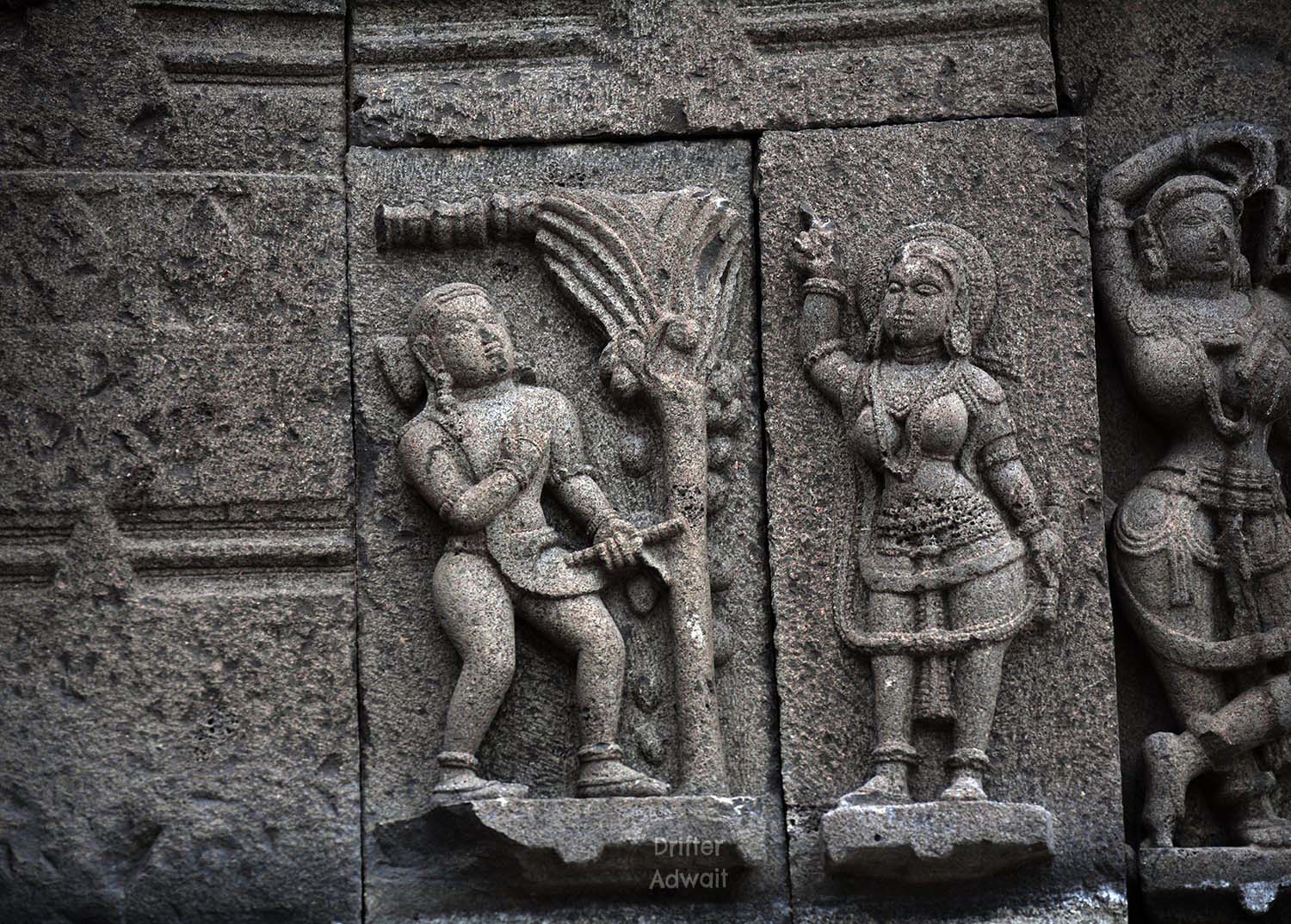
Kanha, sometimes identified as Kanhoba, is portrayed as a Natha yogi. He is shown with matted hair, split ear ornaments characteristic of Natha ascetics, and a staff that likely represents the yogic danda. His posture in the sculpture is restrained and composed, indicating control rather than aggression.
According to the narrative, Kanha entered a dense forest accompanied by his disciples. This forest served as the abode of Bahudi Yogini, a powerful female practitioner. As Kanha entered the forest, the atmosphere transformed. The sound of damarus was said to resound, with hundreds echoing in the sky and on the earth. This auditory imagery signified the presence of intense yogic energy rather than theatrical display.
The Confrontation Between Kanha and Bahudi

Kanha asked Bahudi for a coconut, a request that carried symbolic meaning. In Indic ritual practice, the coconut represents fruition, completion, and offering. Bahudi responded with a challenge. She stated that if Kanha truly possessed yogic power, he should pluck the coconut himself.
What followed was not a physical confrontation but a demonstration of siddhis acquired through sadhana. Kanha plucked the coconut using only his gaze, without any bodily movement. The coconut fell and landed in the hand of one of his disciples. The act was controlled and deliberate.
Bahudi then responded by using her own yogic power. With her gaze alone, she returned the same coconut to its original position on the tree. She displayed no anger or triumph. The act was calm and precise.
This sequence repeated multiple times. Each time Kanha plucked the coconuts, Bahudi restored them. According to the narrative from Leelacharitra, Bahudi defeated Kanifnath in various events, particularly in practices related to advanced esoteric disciplines, including sexual sadhana (most likely Vajroli sadhana). This divine confrontation ultimately culminated in the conclusion of Kanifnath’s avatara, as described in the text. Eventually, Kanha was defeated, costing him his life. The defeat occurred not because Kanha lacked power, but because he had entered a contest centered on the display of power.
How the Sculpture Encodes This Philosophy
The sculptural panel captures this episode with remarkable precision. Kanha is positioned on the left side of the composition, standing upright with his right hand placed on his chest. His gaze is directed toward the tree. Above him, faint indications of damarus suggest the charged environment described in the narrative.
The coconut is shown falling toward the ground, and its downward movement is clearly articulated. On the right side of the panel, Bahudi Yogini is depicted standing firmly, with her gaze lifting the same coconut upward. The sculptor has represented both motions within a single frame.
This is where the Vishnudharmottara principle becomes visible. The falling coconut conveys weight and inevitability, while the rising coconut conveys intention and controlled force. The sculptor has successfully distinguished between two opposing movements without exaggeration, thereby demonstrating mastery of visual logic.
The Philosophical Message of the Sculpture
The central philosophical message encoded in the Kanha and Bahudi sculpture concerns the danger of displaying siddhis. Across yogic and tantric traditions, siddhis are consistently described as secondary outcomes of practice rather than ultimate goals. Patanjali himself warns that attachment to siddhis can obstruct the path toward liberation.
The sculpture does not present Kanha’s defeat as a moral failure. Instead, it presents it as a directional error. By engaging in a contest of miraculous display, Kanha shifted his focus outward. Bahudi’s response serves not as a victory celebration but as a corrective demonstration.
The restraint shown in the sculptural composition reinforces this philosophy. There are no exaggerated gestures, dramatic expressions, or theatrical poses. The lesson is communicated through calm repetition and visual clarity.
Contemporary Relevance of the Sculpture
In contemporary spiritual culture, visibility, charisma, and public demonstration are often rewarded. The Kanha and Bahudi sculpture offers a counterpoint to this tendency. It emphasizes that inner realization does not require public validation and that the pursuit of spectacle can undermine the pursuit of ultimate knowledge.
The sculptor’s decision to emphasize motion, intention, and consequence rather than drama reflects a deep understanding of spiritual psychology. The falling and rising coconut are not presented as opposites but as reflections of the same power directed differently.
Preservation and Responsibility
Many sculptural fragments from this temple lie scattered across the site, broken and weathered. The Vishnu temple near Palasdev requires conservation not for commercial tourism but for cultural continuity. The sculpture of Kanha and Bahudi preserves a philosophical position that remains relevant and instructive.
Visitors to Palasdev who move beyond the more visible landmarks can still encounter this panel standing quietly against the water and sky. Careful observation reveals how stone continues to communicate ideas that textual traditions have long articulated.
Conclusion
The sculpture of Kanha and Bahudi does not teach through direct instruction or doctrinal assertion. It teaches through visual reasoning and consequence. It demonstrates that spiritual power, when treated as proof of attainment, becomes a distraction rather than a guide. The panel emphasizes restraint, inward focus, and the renunciation of spectacle as essential qualities of genuine spiritual pursuit.
In a cultural environment increasingly oriented toward display and performance, this forgotten sculpture offers a disciplined and corrective perspective. It reminds the seeker that the highest form of wisdom does not announce itself, seek recognition, or invite competition. Instead, it remains oriented toward liberation and withdraws from display.


References:
1. Leelacharitra story- १९४ उपासनीयां रोद्धपुरीं वासु निक्षेदु-
उपासनीये’ ते रीद्धपुरा गेले : तीहीं दोघी बाइया सीक्षिणी केलीया : आपणेयां पुजापुरस्कार करवीति : मग कोणें नेणों भगतजनें आलीं : परमेश्वरपुरौनि : तेहीं गोसावीयांपुढां सांघितलें : “जी जी : उपासनीए रीधपुरीं आपणेयां पूजापुरस्कार करवीताति : तेथ मढी केली असे : ” ऐसें गोसावीयांपुढें सांघीतलें : मग आणिकें भक्तजनें परमेश्वरपुरा गेलीं : तयां हातीं गोसावीं निरोप पाठवीला : सर्वज्ञे म्हणीतलें : “उपासनीं” तेथ नसावें : तेथ श्रीप्रभु राज्य करिताति : आपणेयां पुजापुरस्कार न स्वीकरावें : कां स्थानत्यागु करावा : गुरुपस्य अधीकवृती न वर्तावें : ” तयावरि अधिक वृतीचें प्रमाण नीरुपिलें : [ सर्वज्ञं म्हणीतलें : कान्ह वहुडीचेया वनासि आला : सातसें डबुरां अंतराळीं वाजति : सातसें भुमंडळीं वाजति : कान्हें म्हणीतलें : ‘बहुडिये : एक नारियेळ दे कां : ‘ वहुडीया म्हणीतलें : ‘राउळो : सामर्थ्य असे तरि तोडुनि घेया : ‘ कान्हें दृष्टी नारीयेळ तोडीलें : चेलेयाचां हातीं दीधलें : वहुडीया दृष्टीं ब्राहाटिलें : मागौतें देंठीं लावीलें : कान्ह आवघीं नारियेळें तोडुनि खालि पाडी : बहुडी माघौतीं दृष्टी नाहाटी : तियें देंठीं लावी : मग कान्हें म्हणीतलें : ‘ या : आम्हीं तुम्हीं आंगें जुंझों ः मीं आपुलें वीर्ये खीरों नेदीं: तुं आपुलें वीर्ये खीरों नेदीं:’ ‘हो कां:’ मग कान्ह उर्द्धरेता : अधरेत घे : तें उद्धं सोखी : ऐसी बहुडी रोडैली : ते कामाख्येची दासि : तिया पुसिलें : ‘बहुडीये : तुं ऐसी कां ?’ तिया अवघी व्यवस्था सांघितली : मग तिया म्हणीतलें : ‘कान्हु अवीधी खादला असे : तुं रमतां रंध्रीं हीरा धरि : आणि जींकसी : ‘ मग तिया हीरा धरीला : कान्ह सोखूं गेला : आणि ब्रह्मांडीं हीरा बैसला : ‘मर मर वहुडीये : : कपट केलें : ‘ आणि कान्हु पडिला :” सर्वज्ञ म्हणीतलें : ” स्त्रियांचां स्वरूपीं कपट आति : कान्हु काइ वहुडीये जाए ? परि. अवीधीतव गेला : ” सर्वज्ञे परि वारीलें न करीतीचि : एकु दी तेयांसि स्तीति जाली : तेहीं आपणेयांतें अडीं घातलें : तयांचां सीक्षींहीं घातलें : मग आणिकी भगतजनीं येउनि गोसावीयांपुढें सांघीतलें : सर्वज्ञ म्हणीतलें : “पोरा जीवा एथौनि म्हणीतलें तें नव्हवे : मग मरणा म्हणीतलें : “गुरूपसि अधीकवृती न त्तिजे : ” ] मग तीं तो नीरोपु तयांपुढां सांघीतला :सरण जाए’ : ” ।।
2. Gupte, B. A. (n.d.). Hindu holidays and ceremonies. Archive.org. Retrieved January 6, 2026, from https://archive.org/details/in.ernet.dli.2015.447796/page/474/mode/1up
3. Kanifnath iconography study. (2024). Recently deciphered iconographic representations of Kanifnath. Academia.edu. https://www.academia.edu/120902602/Recently_Deciphered_Iconographic_Representations_of_Kanifnath
4. Natha Sampradaya archaeology. (2024). Archaeology of Natha Sampradaya in the Pune District of Maharashtra. Academia.edu. https://www.academia.edu/123253039/Archaeology_of_Natha_Sampradaya_in_the_Pune_District_of_Maharashtra
5. Special Mention
The sculptural panel often identified locally as depicting a toddy tapper does not represent a quotidian occupational scene. As explained by experts Saili Palande-Datar and Laxmikant Sonwatkar, this carving is closely connected to the narrative tradition associated with Kanifnath and the broader Natha sampradaya. Their interpretation provides critical contextual clarity and prevents a reductive reading of the sculpture. The author records sincere gratitude to both scholars for their insight and guidance, which significantly informed the understanding presented in this blog.