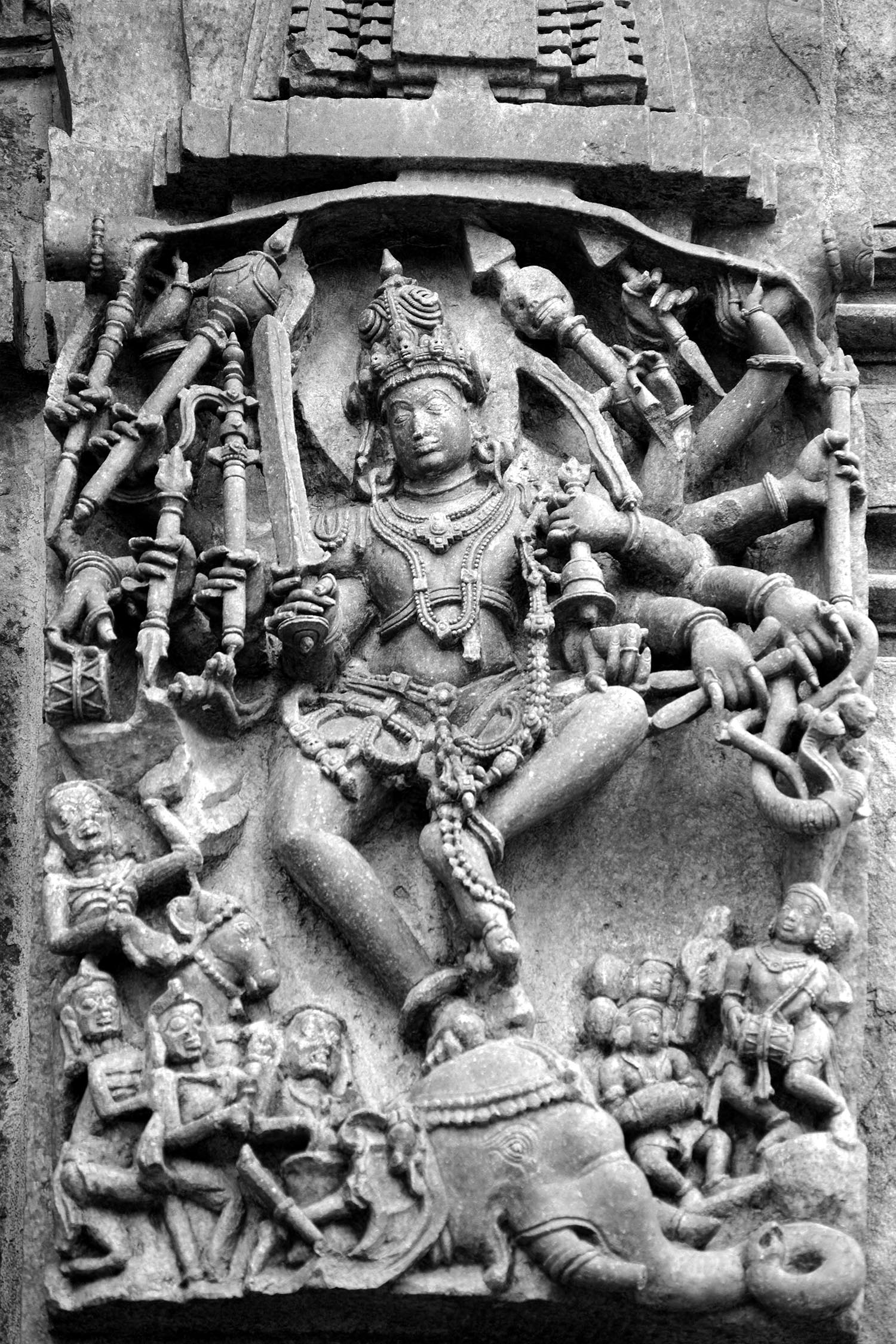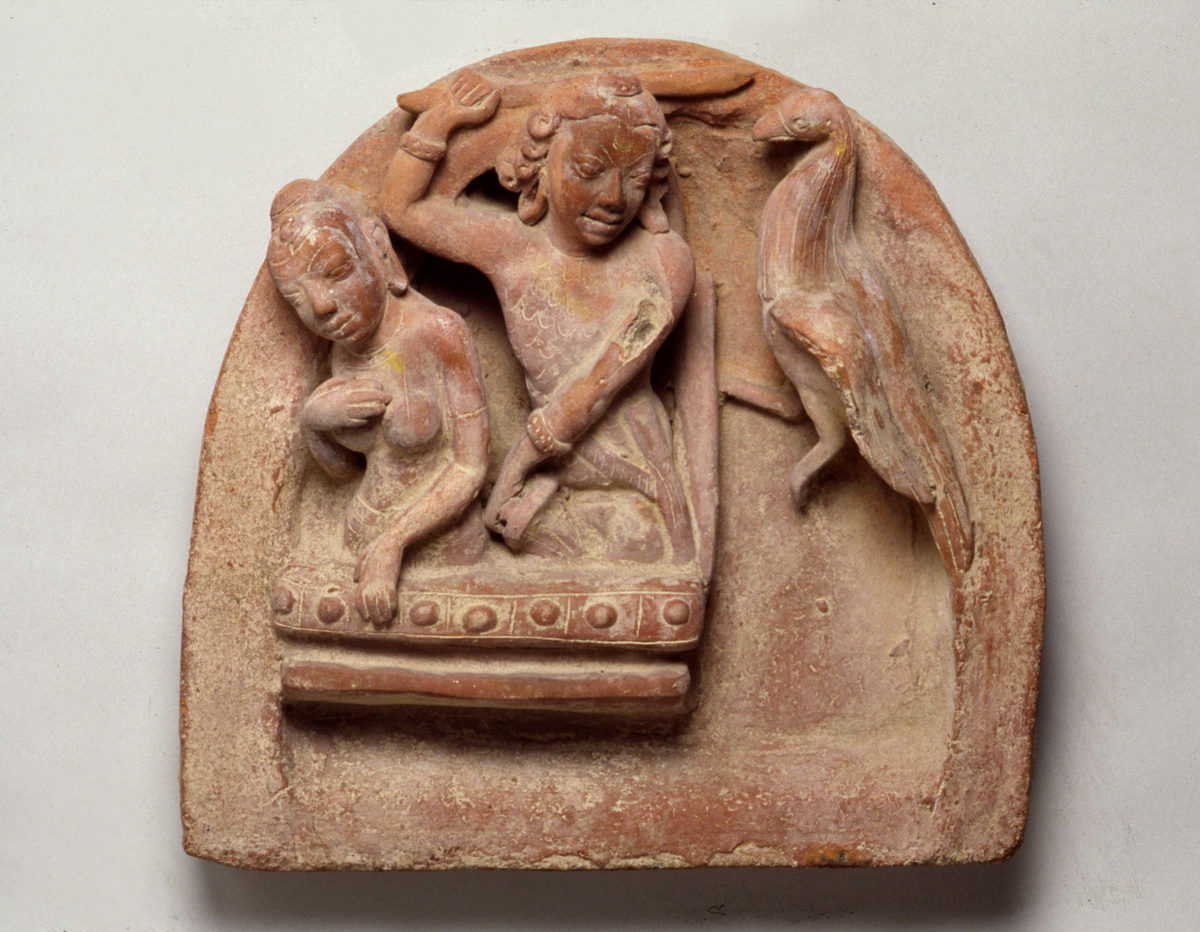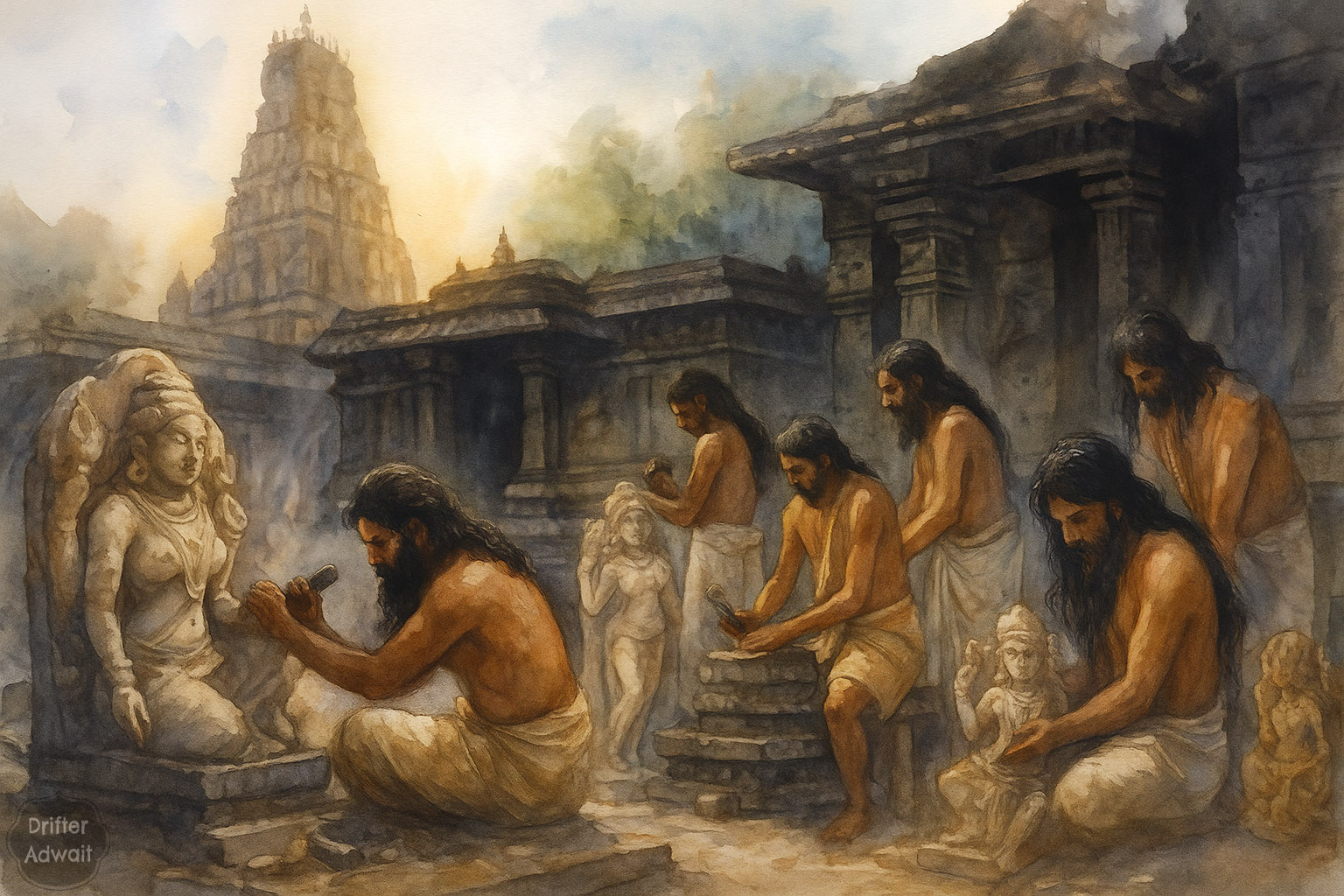
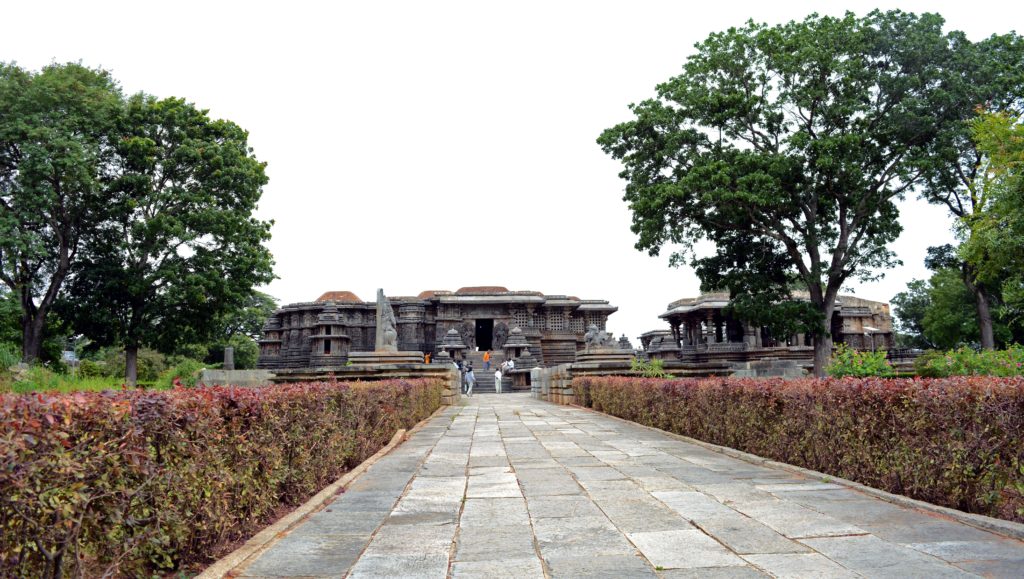
After wandering through the endless sculpted corridors of Hoysaleswara Temple, the eyes slowly begin to surrender. Every inch of stone seems alive beneath the southern sun. Gods rise from the walls like memories from another age. Celestial dancers sway in frozen rhythm. Warriors clash beneath curling vines of stone. Serpents coil around forgotten deities. Lions roar eternally from black chloritic schist polished by eight centuries of rain, incense, and human wonder.
At some point, the mind can absorb no more beauty.
One sits quietly within the temple courtyard, beneath the drifting shade of coconut trees. The gardens around the temple glow softly in the afternoon light. The western gateway, watched over by a serene image of Ganesha, seems almost touched by stillness. The breeze moves lazily through the palms, and for a brief moment the old capital of Dwarasamudra feels asleep beneath the weight of centuries.
And then, almost unnoticed, the gaze drifts toward a solitary pillar standing apart from the crowded magnificence of the temple.
It rests quietly upon a raised platform within the courtyard, far from the great sculptural walls that draw the attention of pilgrims and travelers alike. No celestial maidens dance upon it. No sprawling friezes announce its importance. Many pass beside it without even turning their heads.
Yet this silent stone may be the most important monument in all of Halebidu.
Because this pillar does not merely display art.
It remembers men.
A Kingdom Built Upon Oaths
[अर्थशास्त्र अष्टादशं प्रकरणम् – आत्मरक्षितकम्]
शयनादुत्थितः स्त्रीगणैर्धन्विभिः परिगृह्येत, द्वितीयस्यां कक्ष्यायां कञ्चकोष्णीषिभिर्वर्षधराभ्यागारिकैः,
तृतीयस्यां कुब्जवामनकिरातैः, चतुर्थ्यां मन्त्रिभिः संबन्धिभिर्दोवारिकैश्च प्रासपाणिभिः ।।
Arthashastra Chapter 18: Concerning the King’s Personal Security
Upon the King rising from his bed, female archers should stand in attendance around him. In the adjoining chamber, eunuch attendants—dressed in robes and turbans—should remain prepared to assist with his attire and adornment. In the third chamber, the Council Hall, hunchbacks, dwarfs, and Kiratas should be stationed in service. In the fourth chamber, the Audience Hall, the King should receive his ministers, trusted kinsmen, and spear-bearing guards at the gates.
Royal bodyguards are an ancient institution in India. Even Arthashastra speaks in great detail about the king’s personal safety. Kautilya advises that armed guards — even women archers — should surround the ruler constantly. The sovereign’s body was treated as the body of the kingdom itself. If the king fell, the realm trembled with him.
Yet in most of Indian history, these guards remain like shadows moving behind torchlight.
Kings shine in inscriptions. Generals dominate chronicles. Poets sing of emperors who conquered rivers and mountains. But the men who stood nearest to death, nearest to the king’s own breath, often vanish silently into the darkness of forgotten centuries.
The Hoysalas were different.
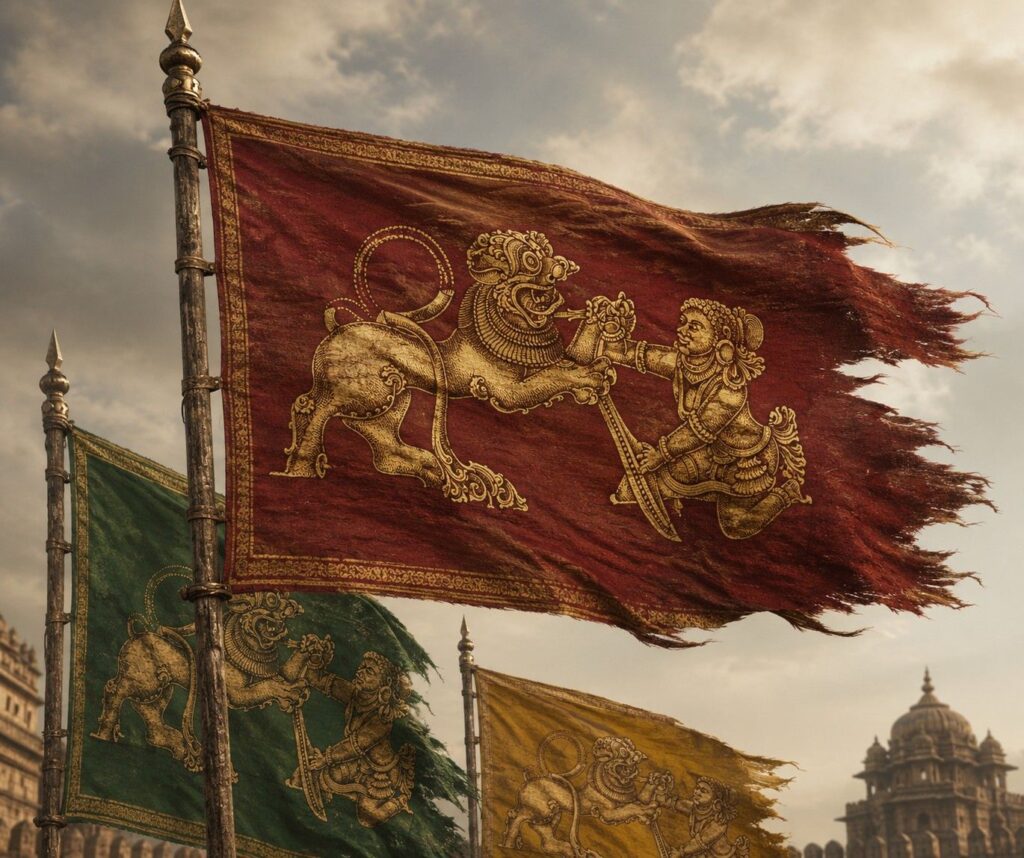
Their royal bodyguard corps was called the Garuda Dal — named after Garuda, the celestial eagle of Vishnu. Just as Garuda never abandons his lord, these warriors swore absolute loyalty to the Hoysala king. Their oath was taken publicly before the people themselves, binding honor tighter than iron.
Their vow was terrifying in its simplicity.
To live with the king.
And to die with him.
To mark this oath, members of the Garuda corps wore golden anklets engraved with the image of Garuda upon their left leg. It was not ornament. It was destiny worn upon the body.
The inscription proudly proclaims:
“There existed one thousand unsurpassed heroes devoted to him, who would abandon even their lives but never desert him in battle.”
These were not ceremonial words carved for vanity.
The pillar exists because those men fulfilled their oath unto death.
“Strike, Sala!” — The Birth Of The Hoysalas
The inscription begins not with death, but with origin.
It reaches back into the legendary dawn of the Hoysala dynasty, when forests still cloaked much of Karnataka and kings rose from shrines, battlefields, and wandering destinies. In those days the world must have seemed larger, darker, and filled with signs from gods and spirits.
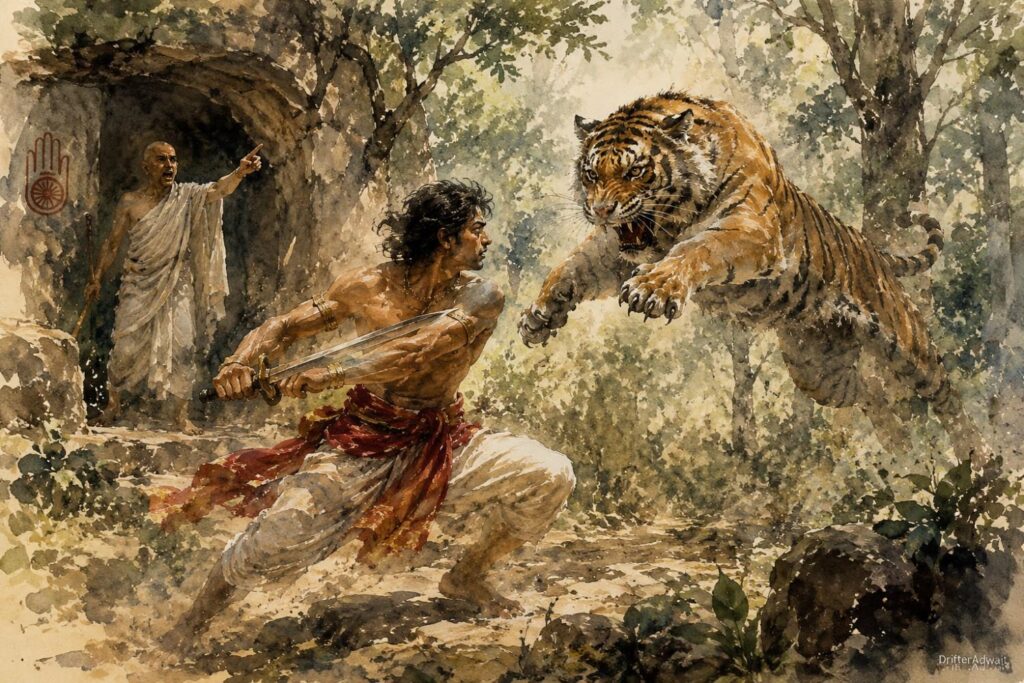
A young warrior named Sala worshipped the goddess Vasantika Devi at Shashakapura. Suddenly, according to the inscription, a tiger sprang from the wilderness upon him. From a nearby cave, his Jain guru cried out:
Hoy Sala!, which means, “Strike, Sala!”
And Sala struck.
The tiger fell dead upon the earth.
From that single cry came the name “Hoysala” — born from the command “Hoy, Sala!” The tiger itself became the eternal emblem upon their banners, carved later into temples, seals, and royal insignia across Karnataka.
The inscription lingers lovingly upon this tale because the Hoysalas did not see themselves merely as rulers. They believed themselves chosen by destiny and sanctified through courage.
Even centuries later, the pillar speaks of enemies fleeing in terror before the “tiger-bannered army.” Kings abandoned fortresses. Armies scattered like frightened birds. Forest strongholds and mountain citadels alike burned before the advance of Hoysala steel.
The dynasty remembered its first battle long after the forests themselves had faded into memory.

Veera Ballala And The Thousand Garudas
The inscription then turns toward Veera Ballala II, perhaps the greatest monarch of the Hoysala line.
The poet compares him to kings from epic memory — Rama, Bhagiratha, Nala, Yudhishthira. Such praise was common in medieval inscriptions, yet the tone here feels strangely alive. One senses not merely flattery, but genuine admiration born from closeness.
Ballala is portrayed as a ruler before whom enemy kingdoms trembled. Mountain forts shattered beneath his campaigns. Forest citadels burned. Water forts collapsed beneath the fury of the Hoysala armies. The inscription describes their advance as a blazing summer fire sweeping across dry earth beneath a merciless wind.
Yet amidst all this thunder of conquest, the inscription repeatedly returns to another figure.
Kuvara Lakshma.
Again and again his name appears beside the king’s, until the reader begins to feel that the poet himself could not imagine one without the other.
“Between the two there seemed no distinction of king and subject.”
Lakshma was not merely a commander. He was companion, adviser, guardian, and almost a foster son to the king himself. The inscription says Ballala entrusted him with authority over the capital city. Elsewhere it calls him the “strong right arm” of the ruler.
And Lakshma was not alone.
His wife, Suggala Devi, too belonged to this sacred brotherhood of loyalty. The inscription suggests that both had been raised almost like children within the royal household itself, educated and cherished beneath the shadow of the Hoysala court.
The poet compares their bond with Ballala to that of Rama and Lakshmana, Krishna and Arjuna. Such comparisons were sacred in medieval India. They implied loyalty beyond politics — loyalty born from shared destiny.
The language is not administrative.
It is deeply human.
Kuvara Lakshma — The Man The Stone Refused To Forget
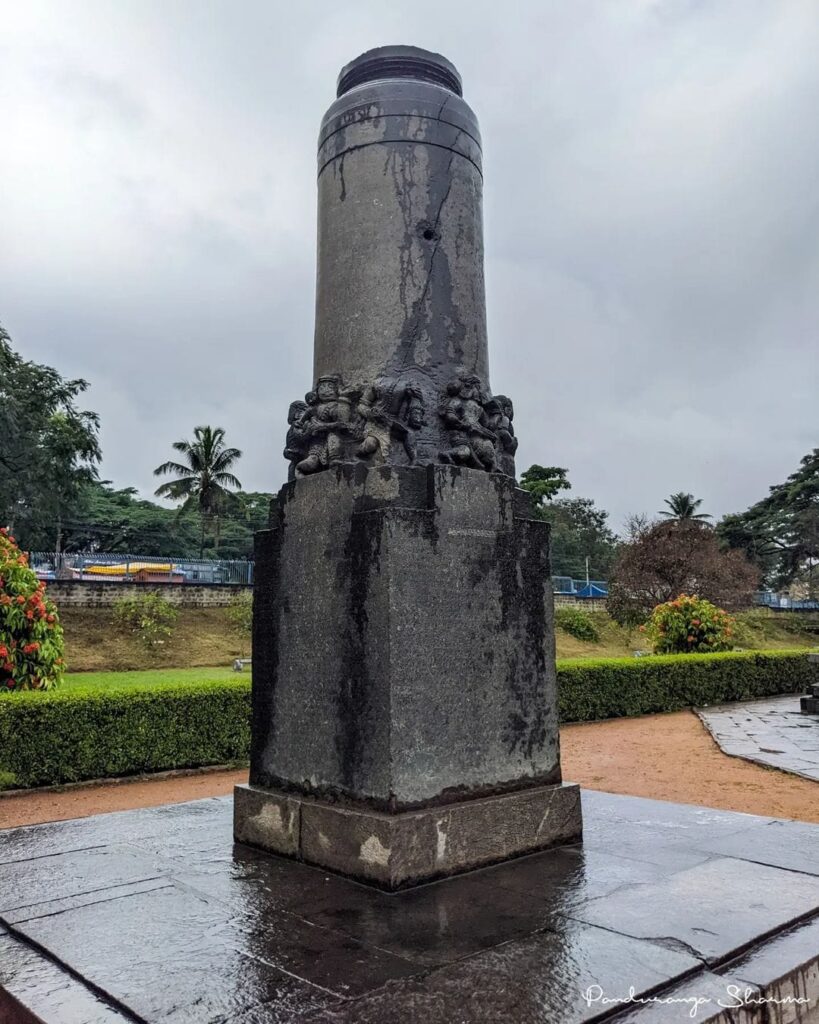
Image Courtesy: Pandurangasharmab1902 (Facebook)
The deeper one reads the inscription, the more vividly Kuvara Lakshma emerges from the stone like a warrior stepping from mist.
He was learned in the sixty-four arts. Skilled in warfare. Generous toward scholars. Stern against enemies. Humble before his king. The inscription repeatedly insists that once Lakshma gave his word, it became “firm like writing carved in stone.”
Perhaps the most striking line says:
“There were only two things he did not know — refusal toward supplicants and defeat before enemies.”
That sentence carries the grandeur of old heroic literature. One can almost hear it recited aloud in the halls of Dwarasamudra while oil lamps flickered against carved pillars.
The inscription portrays Lakshma as the ideal medieval warrior-minister. Fierce in battle, yet compassionate toward dependents. A man whose greatness rested not only upon strength, but upon truthfulness.
One passage says:
“He protected his own body only for the sake of faithfully serving his master.”
That line changes everything.
For men such as Lakshma, life itself possessed meaning only through loyalty. Without the king, existence became hollow, like a sword without a hand to wield it.
Suggala Devi — The Flame Beside The Warrior
Then the inscription turns toward Suggala Devi.
Like many medieval inscriptions, it first praises her beauty through elaborate imagery. Her voice resembles the song of the cuckoo. Her eyes are compared to lilies and startled deer. Her gait flows like swan and elephant alike. The poet lingers over her grace as though reluctant to leave it behind.
Yet beneath all ornament lies admiration for something far deeper.
Devotion.
The inscription says:
“Among virtuous women upon this earth none could equal Suggala Devi.”
She appears not merely as wife, but as companion in destiny. The poet compares her fidelity to Arundhati herself — the eternal symbol of loyalty in Indian tradition.
One begins to sense that Lakshma and Suggala were seen almost as twin flames moving through the royal court together. Their loyalty toward Ballala was shared so completely that even the inscription struggles to separate their identities.
And that loyalty would soon demand everything from them.
Death Of The Emperor
Time, which conquers all kingdoms beneath the sun, finally reached Veera Ballala.
The inscription does not dwell dramatically upon his death. Medieval inscriptions often speak softly about mortality, as though reluctant to admit that even great kings vanish from the earth. Yet behind the restrained language one senses an enormous grief moving silently through the court of Dwarasamudra.
For Kuvara Lakshma, Ballala was not merely sovereign.
He was purpose itself.
The pillar tells us that after the king’s death, Lakshma and Suggala Devi ascended a raised platform within the capital city.
There, before witnesses and fellow warriors, they fulfilled the ancient oath of the Garudas.
Both took their own lives with their own swords. Beheading themselves.
No enemy surrounded them. No battlefield demanded the act. No conqueror stood victorious above them. This was not defeat. It was loyalty carried to its final and terrible conclusion.
The Thousand Garudas
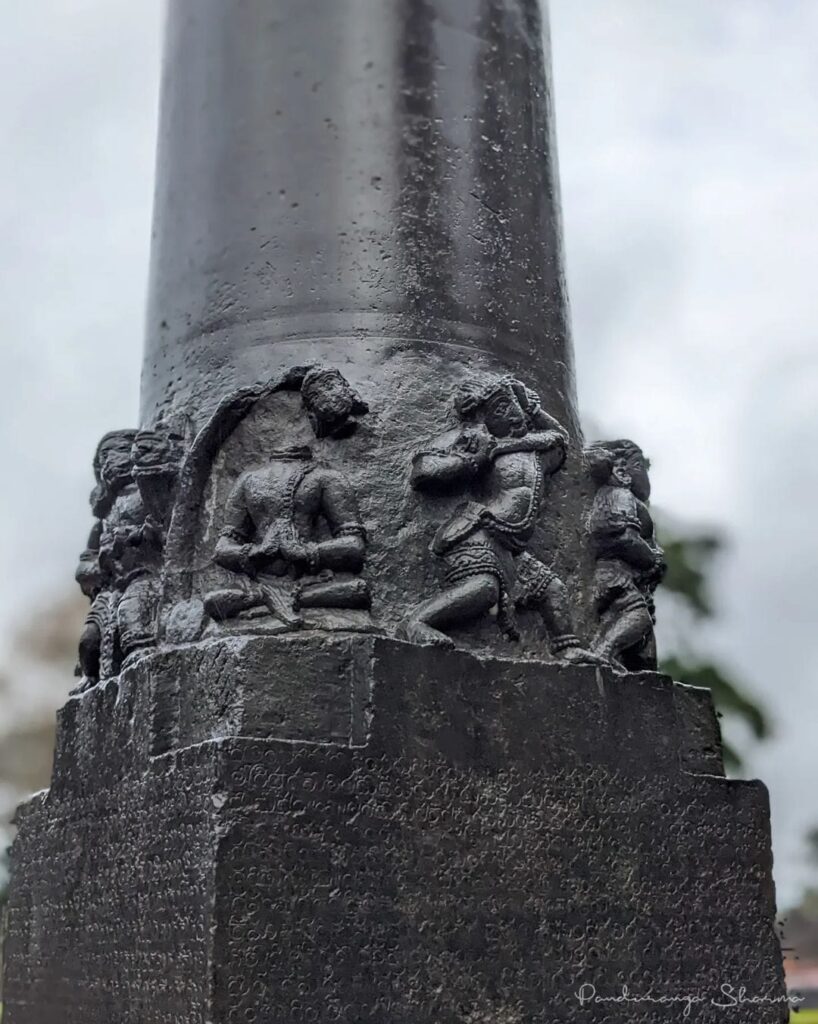
Image Courtesy: Pandurangasharmab1902 (Facebook)
And then came the moment that transformed memory into legend.
The thousand Garuda warriors who served beneath Kuvara Lakshma chose to follow him into death.
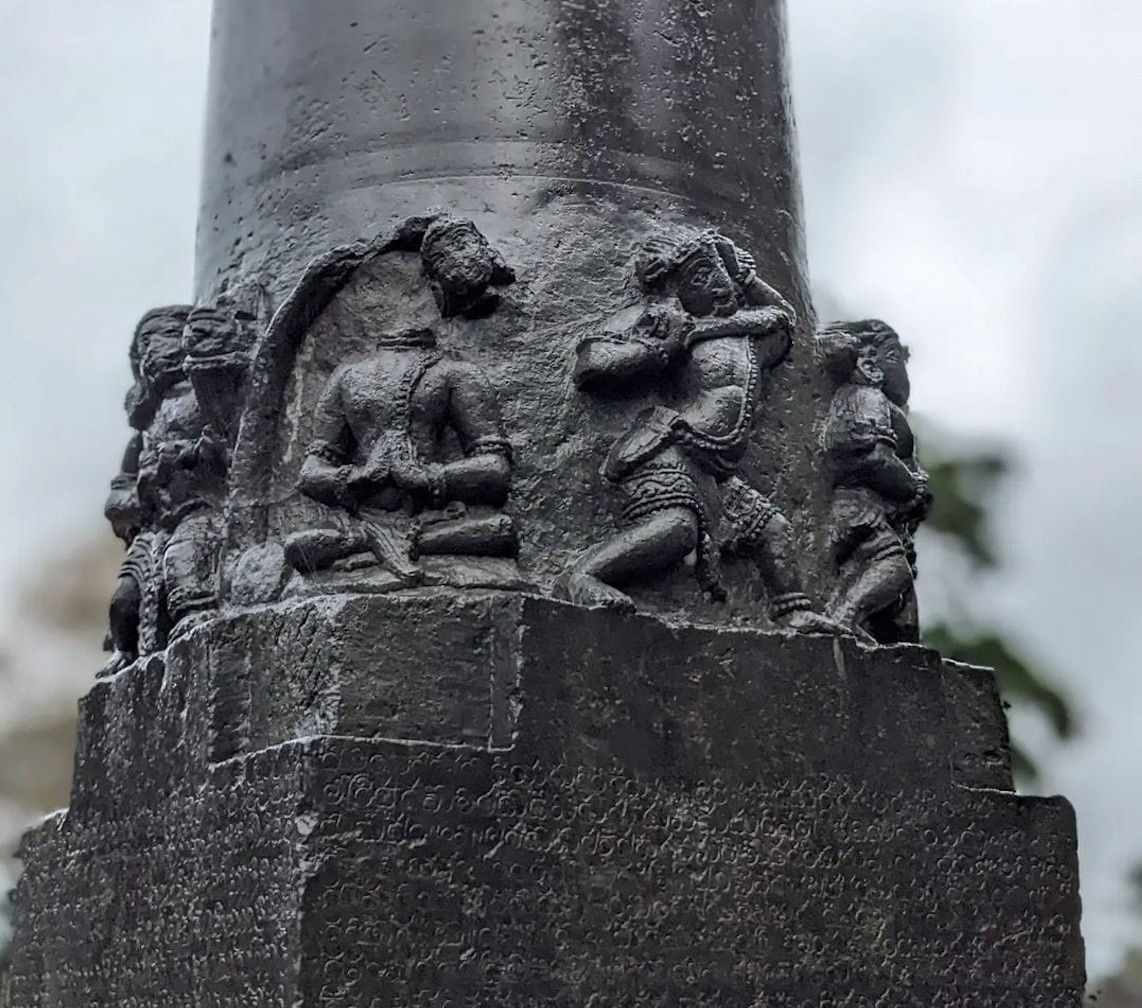
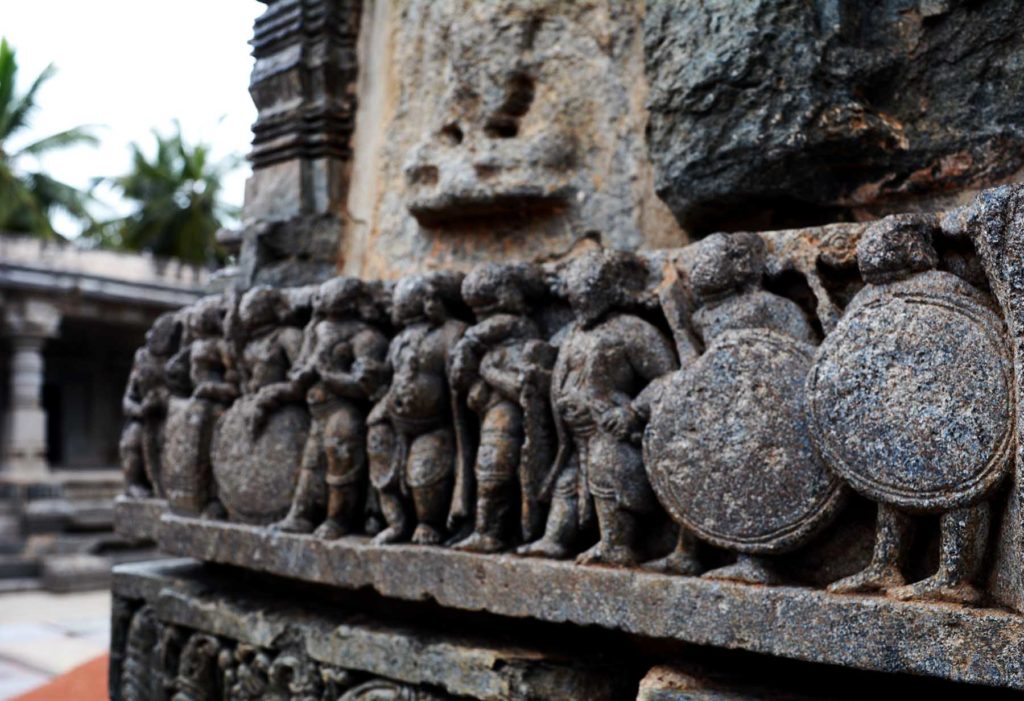
Some severed their own limbs. Some sat in meditation and pierced themselves with blades. Others performed a ritual so haunting that even centuries later it unsettles the imagination.
They bent bamboo poles deep into the earth and tied their long hair to them with cords stretched tight as bowstrings. And when they were beheaded, the released bamboo hurled their severed heads skyward like stones flung from a sling.
Even today, tiny carvings upon the pillar preserve these final acts in miniature stone forms. Small human figures appear across its surface, each depicting a different form of self-sacrifice performed by the Garudas.
The imagery feels almost unreal, like something from an ancient saga carried across generations by trembling voices beside firelight.
Yet the inscription speaks of these acts not with horror, but reverence.
“We shall not survive if we abandon him.”
That was the creed carved into their hearts.
And, into this stone.
Where Loyalty Becomes Worship
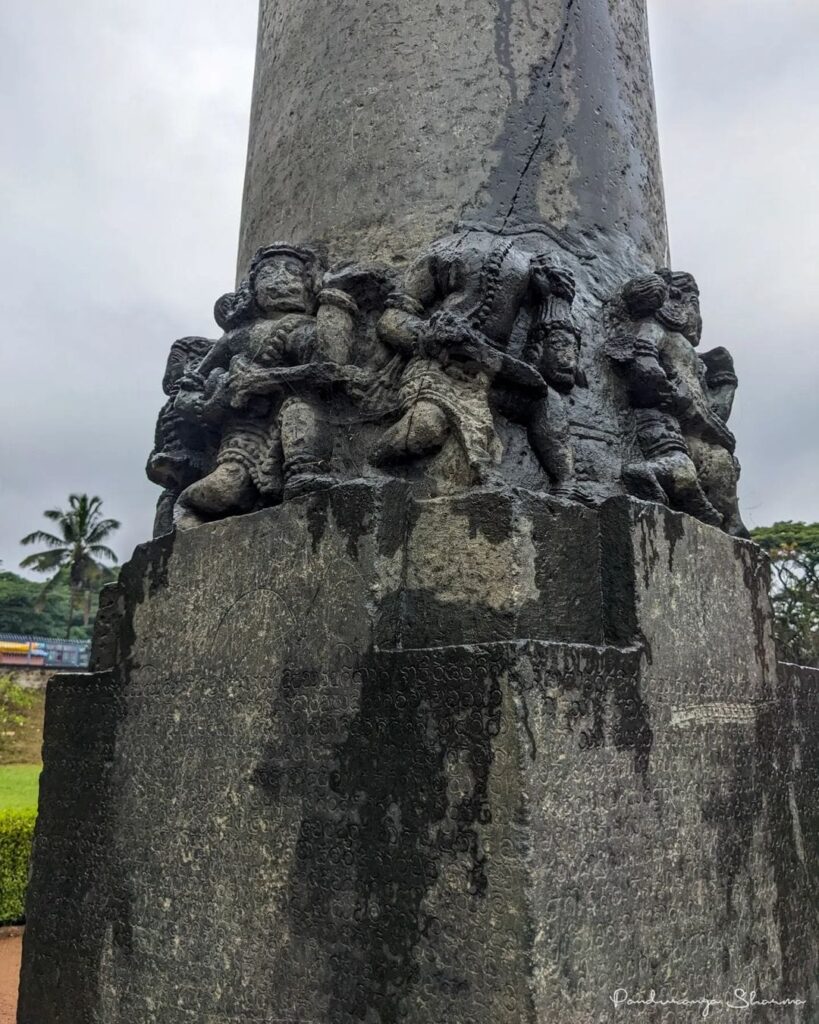
Image Courtesy: Pandurangasharmab1902 (Facebook)
Standing before this pillar for long enough, one begins to feel the boundary between devotion and worship slowly blur.
Even today, stories emerge from South India of admirers taking their own lives after the death of beloved political leaders or cinema stars. Such acts often appear shocking to outsiders, yet before this pillar they suddenly feel ancient, almost ancestral.
The same emotional intensity stands immortalised here in Hale Kannada script.
The pillar becomes more than inscription. It becomes a mirror into the emotional world of medieval South India. A civilisation where loyalty could rise beyond reason and become something sacred, frightening, and eternal.
One cannot help but think of the samurai of Japan, who embraced death before dishonor. Even during the Second World War, stories spread of Japanese soldiers choosing death over surrender. Yet the sacrifice of a thousand warriors purely for love of their king remains extraordinarily rare in human history.
This pillar is therefore not merely a memorial.
It is a monument to oath, honor, grief, and terrifying fidelity.
A monument so fierce in spirit that even the gods themselves might look upon it with envy.
The Stone That Outlived The Empire
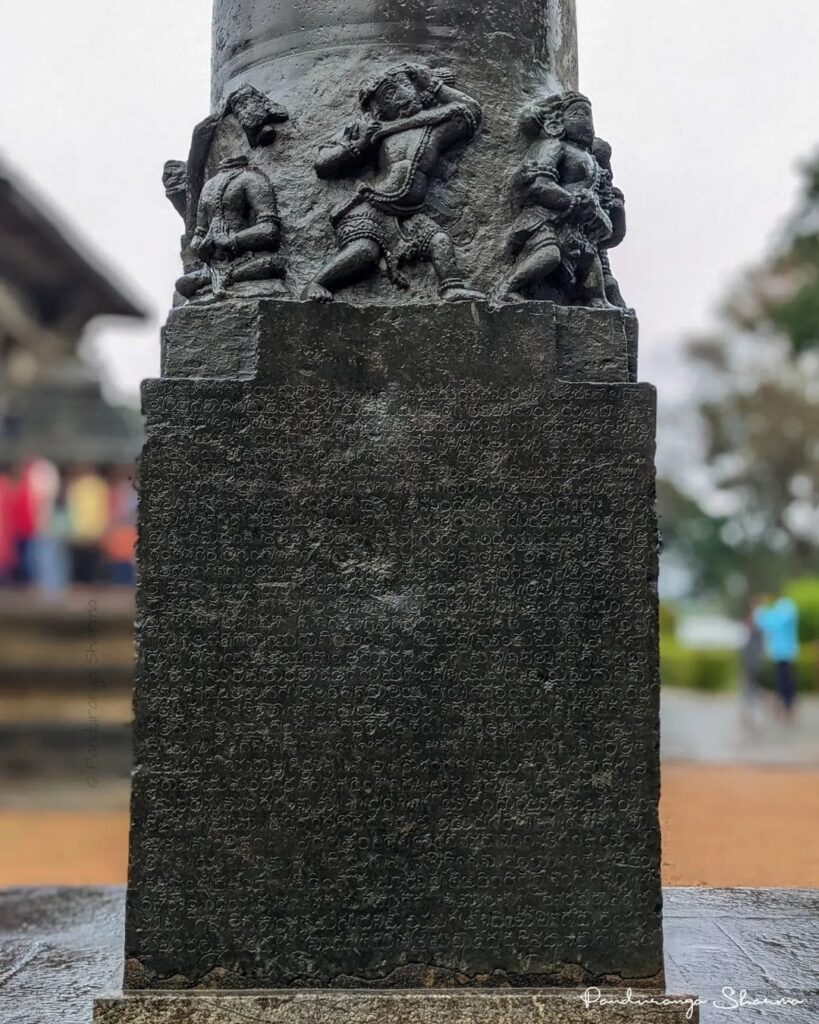
Image Courtesy: Pandurangasharmab1902 (Facebook)
The Hoysala Empire eventually faded beneath invasions, wars, and the slow turning of centuries. Dwarasamudra fell into ruin. Armies vanished into dust. Royal halls collapsed beneath vines and monsoon rain.
But the pillar remained.
Its Hale Kannada verses still breathe with astonishing life after eight hundred years of sun and storm. The tiny carved figures upon it still preserve the final moments of the Garudas. The names of Kuvara Lakshma and Suggala Devi still survive while countless kings elsewhere have disappeared into silence.
Most visitors come to Hoysaleswara Temple seeking sculptural beauty.
Few stand long enough beside this stone to hear what it is saying. Yet perhaps this pillar is the true soul of Halebidu. Not because it celebrates conquest, but because it preserves memory with painful honesty.
It remembers loyalty so absolute that it crossed into death itself. It remembers a world where promises outweighed life. It remembers men who believed honor could outlive flesh and empire alike.
So when you next wander through the shadowed courtyards of Halebidu, pause beside this lonely pillar for a while. Remember Kuvara Lakshma. Remember Suggala Devi. Remember the thousand Garudas who followed their oath into eternity.
And listen carefully.
After eight hundred years, the stone still refuses to forget.
For Interested Readers, this is the original poem Inscribed on the Memorial Pillar at Hoysaleshwar Temple, Halebidu.
Part 1:
Sri namas tunga- oto || śriyam Sridharan âyuvam Vanajajam Gaurivaram kirttiyam | käyakk oppuva kantıyam vidhu dınēšam tējamah Bhôgini | jyayam bhôgaman enbarum dıg-adhipar tan-tammol ull olpan old | îyutt irkke kumāra-Lakshma-rathınî-nathang atı-pritzyń Šri-dayitam Yadu-kuļadola-1 g âdam Saļan emban orvva-nrıpan å-nripanınd âdudu Šašakapuram adarkk | åd adhıdaıvam Vasanta-vallabhey embol va || a-nripõttaman a-Šašakapurada Vasantıkü-devıyan ärādhısuva samayadol ad-ond abhila-šårddûlam pâydode | keladoļ irdd upadēšakanum uttara-sādhakanum appa Jina-munipõttamam bettava seleyı nim pulıyam poy Salay endod a-Sala-nripange Poysalābhidhanam adud ā-šarddüļam pataka-pravirajita-chitra-chihnam adud | a-Poysaļanvayadol âdıtya-tējam Vinayâdityan embôn apratima-pratāpam narapan âdôn | âtan-atmódbhavan î-dharavanitegav Échala-Devigav erevan Erevanga-Dévan embên arasan ädön åtan adı-kshatriya-pavitram kadana-Triņêtran | å-samyaktva-chûdâmanige ratna-trayangal udbhavisuvante | Ballâļa-Dēvanum Bıttı-Dêvanum Udayaditya-Dêramum emba mûvar arasugal âtmajar ådor avaroļe Vishnuvardhanane višada-yašő-vırājítan âdom | via-Vishnu-kshitipālakange tanujātam Narasimhõrvvipam bhu-vandyam tanujatan a-nrıpa-varang ambodhi-maryâdey-ad-1 f-višvambhareyam nijõnnata-bhuja-stambhāgradol taldıdam | Devendrâdrı-samâna-mâna-mahımam Ballala-bhūpālakam ||
English Meaning:
“Reverential salutations to the exalted Lord.” ||
“May prosperity from Sridhara (Vishnu), long life from the lotus-born Brahma, fame from the husband of Gauri (Shiva), beauty equal to Manmatha, radiance equal to the moon and the sun, and enjoyment surpassing that of the serpent-lords,” |
“victory and pleasures praised even by the guardians of the directions — while all these remained united in him, the beloved of Lakshmi, greatly cherished by fortune,”
“In the Yadu lineage there was a king named Sala; by that king was founded the city called Shashakapura.” |
“The presiding deity there was the goddess called Vasantavallabhe.” ||
“That excellent king, while worshipping the goddess Vasantika Devi at Shashakapura,”
“was suddenly attacked by a ferocious tiger.” |
“The venerable Jain sage, who was his spiritual preceptor and guide,”
“from the mountain cave cried out: ‘Strike, Sala!’”
“From that event the king Sala obtained the name ‘Poysala’ (Hoysala).”
“And the tiger became the splendid emblem upon their banner.” |
“In that Hoysala lineage there arose a king of sun-like brilliance named Vinayaditya, a ruler of incomparable valor.” |
“To him was born, through queen Echala Devi, a king called Ereyanga Deva.”
“He was the purifier of the Kshatriya race, a third eye in battle.” |
“As though the three jewels themselves had arisen in the crest-jewel of righteousness,” |
“three princes were born to him: Ballala Deva, Bitti Deva, and Udayaditya Deva.”
“Among them, Vishnuvardhana shone with spotless fame.” |
“To that protector of the earth, Vishnuvardhana, was born Narasimha, revered by the world.”
“To that excellent king was born one who upheld the earth itself upon the lofty pillar of his mighty arms, just as the ocean upholds its proper boundaries.” |
“That king was Ballala Bhupala, whose majesty equaled Mount Meru itself.” ||
Part 2:
dvishad-urvvipâlaram vikrama-guna-nılayam Vira-Ballala-Dévam | vishamaranyangaloļ nirjjara-yuvatiyar-utsańgadol tamma rājya- | bhishava-byasangado) sangaradol edari benn ıttaram sattaram tann | 1shuving ûdâgad al-âdaran ırısidan êm bhûpar int ågavėda Nriga-Nala-Nahusha-Yudhishthira-1 Sagara-Bhagiratha-Dilipa-Puruputs-Ayur-1 gGaganachara-Bharata-Rama-1 dıgaļ alavê negaļda-Vira-Ballala-nrıpam nrıpar årum Vira-Ballalanol adırade mârâm(ta)parë mirı šårddû-| la-pataka-dandam alladıdode manadol alladuvar ppulle-vindan- | te polań-gond oduvar ponmida bhayad odavim sangara-kshônı… | ..gâmpu vêd âv arıyadar olarê kâduv-anm-ulļa gandar || Vikkeyan irppe ya Kõvaņan irppa Hânugal | Pokkıle Saivuņar vvalidu nında negalteya Lokkigundi lô-kakke kolalke bârad enıp aggada Pandyana betțu gotta nir- 1 akkaradante (west face) Poysalana dhalıya gâlige kettuv allave gırı-vana-jala-durggangala- | irad odevudu suduvudu pudı-1 n uravaniyni pavivol agnıvol grishmadavõl vare tavıpudu Yadu-nrıpāla-kopātopam || vri || asad-alapakke pakk-âgada nudi todardand ârumam yuddhadol bhań- | gisı gellam-golva šauryyam nered ereye budha-šrênı pând îva dâna- | byasanam maryyâdeyam dânțade vasumatiyam kava kârunyam avong | esegum Ballala-Dêvang eseguv amama bhûpâlar int agavēda ene negald á-nrıpôttamana mantrı-šıkhâmani vandı-brinda-Nan-1 dana-vana-mâdhavam kharakara-pratimôrıjıta-tējan ahava-| vaniyol arati-bhübhujaran ıkkuva takkina Vikramārjjunam manuja-Mahėšvaram kuvara-Laksman anindita-vira-vamšajam || ka aramane toțțile negalv – 1 daram adu bây-enne dâdiyar ttann-antah-1 puram ene Ballala-nripam | poreda magam kuvara-Lakshma-dandadhišam guruvum daivamum âldane | paratregam tanag ihatregam peran orvvam | 171 dhareg esedoṁ kuvara-Lakshma-dandadhišam || tanag illa daivam ill ene | aramane neramane nam narapati tanag apta-parijanam sachivar enal | dore-vadedam Ballalana | purad aļavige kuvara-Lakshma-dandadhišam v åtana kânte Kantuvına kântege Ramana bhâmeg Abjasan- | jåtana chitta-vallabhege Rudrana mey-vodavada Bhûdharöd- | bhûtege chandran-anganege någana nagınıg îke põlve yî-1 bhûtaladol perar ddoreye Suggala-Dêvige rāya-ranıyar värija-darppanendu-mukhi vâraņa-hamsa-mayûra-yane kal-hara-kuranga-machhya-nıbha-lôchane kõkıla-charu-kira-vi- |
English Meaning:
“King Vira Ballala, abode of valor and virtues, lord of the earth girdled by the oceans.” |
“In difficult forests and battlefields, while celestial maidens longed to embrace him, he remained devoted only to the practice of ruling his kingdom.” |
“In battle, whether enemies turned their backs, fled, or died, he never allowed dishonor to touch his fame.” |
“What kings could equal him? Were not Nriga, Nala, Nahusha, Yudhishthira, Sagara, Bhagiratha, Dilipa, Pururavas, Ayu, Bharata, and Rama themselves surpassed by the renowned king Vira Ballala?” |
“No king could stand before Vira Ballala; terrified foes fled far away from the tiger-bannered army.” |
“They ran in fear like frightened birds startled within their hearts, scattering across the golden earth in dread of battle.” |
“Even hidden enemies dwelling in forests could not escape his pursuit.” ||
“Whether Vikkeya remained, whether Kovana remained, whether the Hanugals, Pokkile chiefs, Saivunas, or the proud rulers of Lokkigundi stood firm —” |
“the mighty Pandya, who thought himself impossible for the world to overcome, was struck down.” |
“Was it not the storm-wind of the Hoysala army that shattered mountain forts, forest forts, and water forts?” |
“It broke them, burned them, reduced cities to dust, and scorched the earth like blazing summer fire born from the wrath of the Yadu king.” ||
“In debate no false speaker could stand against him; in battle he crushed hostile armies and won complete victory.” |
“He possessed overflowing heroism, honored assemblies of learned men, delighted in generosity and gifts,” |
“upheld proper conduct and protected the earth with compassion.” | “What other kings could equal the greatness achieved by Ballala Deva? Thus was celebrated that supreme king.” |
“His crest-jewel among ministers was Madhava, delight of assemblies of bards, radiant as the sun, unconquered in splendor,” |
“a Vikramarjuna who subdued hostile kings upon the battlefield, a human Maheshvara, Kuvara Lakshma of flawless heroic lineage.” ||
“The royal palace was his cradle of glory; the inner apartments themselves seemed to belong to him.” |
“King Ballala entrusted authority to Kuvara Lakshma Dandanayaka, who became his teacher and divine guide.” |
“For him there was none greater either in this world or the next.” |
“Upon the earth shone Kuvara Lakshma Dandanayaka.” ||
“He would say: ‘I have no god apart from him.’” |
“In the palace and outside the palace, the king regarded him as his intimate companion, kinsman, and minister.” |
“King Ballala entrusted the administration of the capital city to Kuvara Lakshma Dandanayaka.” |
“His queen — to whom Kama himself would be a lover, to whom Lakshmi would be beauty, to whom Brahma-born Sarasvati would be beloved, to whom even Rudra’s mountain-born consort might be compared —” |
“on this earth no other lady could equal Queen Suggala Devi.” |
“Among royal women she was lotus-faced and full of pride in beauty; her gait resembled that of an elephant, a swan, and a peacock.” |
“Her eyes were like lilies, deer, and fish; her voice sweet as the song of the cuckoo.” |
Part 3:
ņā-rave koka-tāla-phala-hêma-ghata-stani yendod ârum 1-1 dharimyol vadhüttamege Suggala-Dêvige põlvey apparê i-dhareyol negalte-vaded irdda patıbratad unnatike tâm sadhane-võytu mun-negald-Arundbatıyol paded igal îkshısal sâdhane-võytu pempu-vaded ırdda patibratad unnatakke La-1 kshmidhara-dandanāthana manah-priye Suggale-Devi-râņiyol al aras emba bhedam ınıtappodam ill ıvasallı tējamum | lileya rājya-chihnamumav irvvarolam saman enduv embınam pâlısuvar ddhara-valayamam paramõtsavadınde Vira-Ba-1 llāļa-nrıpāļanum kuvara-Lakshma-chamûpanum êm sa-punyaro || emba negaltegam pogaltegam orbbuliyad irvvara jasamum urvviyol parvvipa gandu-gondu pasarıse dhanamum prânamum emb ıvam kuvara-Lakkshmam Vira-Ballala-Dê-vana dânônnatigam jayõnnatıgam îyal pûndu mund attu Rå-| mana biding Anuvam Yamātmajana biding Arjunam Chandraju-| tana bidinge Kumâran irppa teradiņd ırddappan êm dhirano || sadhısi kottan āļda Yadu-vamša-namēruge küde dakshıņām-| mbodhi-varam dhara-valayamam budha-kotige kõttan artthamam sadhane-võytu sarvva-nıdhiy embinegam dorey år kkumara-L-1 kshmidhara-devanoļ pati-hita-kramadoļ paded îva-dânadol vinaya (south face) da permme Lakshmige vıvēkada mey-šırı Vânıg asritargg | anunayadındam îva-bage dana-gunakke kadangi sangara | vaniyol arâtiyam tavıpa takku jayanganeg igal alte ne- | ttane dorevettud î-kuvara-Lakshma-chamûpanol âda sangadım ekka-vadan dal i-kuvara-Lakkeyan âdida matu kallol tt-1 akkaradante satya-paripāļana-šilļaman ulluv âva-ka-1 ryyakkam anartthakam perara mâtu vicharısi nôde nirol itt akkaradante satya-paripāļana-šîlaman ullav ellıyum 22 aruvatta-nālku-kalegalo-| Į ariyada kaley ılla kuvara-Lakshma-chamûpang | arıyaduv erad olav ill-ena- 1 arıyam sõlt ariyan artthigam pagevangam || atam patı-bhaktı-saman-1 vitam Ballala-bhümıpâlange jagat- | pûta-charitram kottam vita-bhayam basheyam pratapa-vınûtam || todaram dêsege kâlol ıkkı paded arttham bisaram-bogadant | odalam rakshısı nambıd-äldan-edarol mattondu santanamam | pıdıv-udyogadin irpp amâtyar eneyê Ballala-Dêvange sań- | gadav entappedeyallıyum kuvara-Lakshmam tane tâtparyadım todar eda-galol oppuvudu ballıgey ammada dhan gikke balp | odarısuv ondu-bhangıyole pondodarol todad-ırdda påpegal 1 todara todarppinol todaral anmada bhashey-amâtyar añjı kål- | vıdıdavol irppuvêṁ kuvara-Lakshma-chamûpatıg int id oppade muttına pendeyam Muraharam Kanakadriyoļ andu Šēshanam | suttida-bhangıyındam esed irppudu ponna todartt ad adrıyam | suttıda karnnıkâra-vana-mâlevol irppudu kotta-bhasheg achch | ottida-malkeyim kuvara-Lakshma-chamûpana pada-padmadol todarum papegalum jhaņajhjhana-ravam kaig anme vâmânghriyol | nudıyutt irppuvu kotta-bhāsheg ivanol matt ârum ên ärpparê ! nudidant anmal ad enduv emba nudıyam Ballala-Devange kai-1 pıdıyum kattida gênuv îtane valam dandēša-Lakshmidbaram târagey-ante talt eseva muttina mottadın âda ganda-pen-1 dâramum ikke champaka-navõdgamad-amada-chalvan âldu vå-1 maruna-padadol poļeva pon-dodarum patı-bhaktı-yukti-vi-1 stara-kumāra-Lakshma-rathint-patig oppuguv oppav anyarol katala-tala-tolaguttum paj- jalısuva mauktikada pendeyaṁ vishnupadakk |
English Meaning:
“Her voice was like the cuckoo’s song; her breasts resembled coconuts, palm fruits, and golden pitchers — thus people spoke.” |
“Among virtuous women upon this earth none could equal Suggala Devi.” |
“For the greatness of devoted wifehood, which had once belonged to the famed Arundhati, she now seemed to have attained and surpassed that excellence.” |
“In the lofty ideal of chastity and devotion, Queen Suggala Devi, beloved of Lakshmidhara Dandanatha, flourished in greatness.” |
“Between the two there seemed no distinction of ‘king’ and ‘subject’; in splendor,” |
“in royal insignia, and in majesty, both appeared equal.” |
“Thus, with supreme joy, King Vira Ballala and commander Kuvara Lakshma together protected the circle of the earth as two men of immense merit.” ||
“Their fame and glory spread through the world together without rivalry.” |
“Considering wealth and life itself insignificant, Kuvara Lakshma advanced the generosity and victorious glory of Vira Ballala Deva.” |
“As Lakshmana stood beside Rama, as Yama’s son stood beside Yudhishthira, as Arjuna stood beside the moon-born hero Krishna,” |
“so stood this steadfast and courageous man beside his lord.” ||
“He conquered and administered the southern ocean boundary for the Meru-like lord of the Yadu lineage.” |
“He granted wealth to multitudes of learned men and distributed riches across the circle of the earth.” |
“People declared that Kuvara Lakshmidhara Deva had attained the perfection of being a treasury of all virtues.” |
“In acts beneficial to his lord, in generosity, humility,” |
“wisdom, patronage of dependents, kindness toward supplicants, liberality, and noble qualities in battle,” |
“in burning down enemies and securing fitting victories, there was none equal to Kuvara Lakshma Chamupa.” |
“Whatever word this Kuvara Lakkeya spoke became firm like writing carved in stone.” |
“He possessed a nature devoted to truth and fulfillment of promises.” |
“In every matter, before deciding whether another’s words were useful or harmful, he carefully examined them.” |
“Everywhere he upheld steadfast truthfulness.” |
“He was accomplished in the sixty-four arts.” |
“There was no art unknown to Kuvara Lakshma Chamupa;” |
“there were only two things he did not know — refusal toward supplicants and defeat before enemies.” ||
“With devotion toward his lord,” |
“he bestowed upon King Ballala, ruler of the earth, a fame purified before the world, fearless speech, and celebrated valor.” ||
“He brought wealth from distant lands and distributed it without selfish enjoyment,” |
“protecting his own body only for the sake of faithfully serving his master; among ministers there was no other offspring-like servant equal to him.” |
“Among all ministers serving Ballala Deva, in every matter Kuvara Lakshma alone acted with complete dedication.” ||
“As a creeper clings beautifully around a tree, as a girdle clasps firmly around the waist,” |
“so did his loyal service remain inseparably attached.” |
“Other ministers trembled in fear and withdrew,” |
“but none could equal Kuvara Lakshma Chamupati.” ||
“Like the pearl-garland adorning Vishnu upon Mount Kanakagiri, with Shesha coiled around him,” |
“like a golden ornament encircling a mountain,” |
“like a wreath of blossoming karnikara flowers,” |
“so shone the pledged word resting at the lotus feet of Kuvara Lakshma Chamupa.” ||
“The anklets and ornaments at his lotus feet resounded with jingling music,” |
“and concerning the promises he had given, who indeed could speak otherwise of him?” |
“‘What he has spoken shall never fail’ — thus did King Ballala Deva hold firmly to him.” |
“He was the strong right arm of Dandesha Lakshmidhara.” ||
“Pearl necklaces shining like stars adorned him,” |
“together with fresh champaka garlands fragrant with pollen,” |
“and golden ornaments glittered upon his graceful left side.” |
“In devotion and loyal affection toward her husband, the wife of Kumara Lakshma excelled all other women.” ||
“Like a pearl ornament gleaming within the depths of the ocean,” |
“she shone at the feet of Vishnu.” |
Part 4:
alavatțud ondu Dhuva-man- vaa-kumara-Lakshmidharan amara-mahidhara-samana-mânônnatam | kirttı-mahimõnnatam | Ballāļa-bhūmipāļan-oda-doredu todaran ikke tann ânmana patı-bhaktige mechchi mechchu pochcham-bôgade | dalad andade kuvara-Lakshman anghriyol esegum || priyey î-Suggala-Devi bhasheyan ila-chakram pogalvannegam eda-galol todaram todarchchi patiyam bélmadı ninn ondu pım- | badinol malvaval allen endu sukhadind und uttu kālam karutt | Jayasımha-kshıtıpâlakange jagam ellam bannisal pundu bhā-| sheyan &-Suggala-Devı koțța teradim Ballala-bhüpôttama- | priya-putrange kumara-Lakshma-rathînî-nathange kottal manah- adasal puchchaļiv anya-kāminıyaram rödaduvant ikkıdal | todaram Suggala-Dévı tann edada-pädâmbhôjadol lileyıń dharege negalte-vett eseva-šaktige Šûdraka-bhûbhajange bha-1 suram ene bhashe tan (east face) nerapuv aggada birara dayva-dayvadım | bare su-bhatõttamar kkuvara-Lakshma-chamûpatig ittu bhasheyam | dhare pogalvannegam nerapur aggada virar ad ondu-säsiram perag uidam toredu satt avana vêļe dal a-1 toredar kkalı-kuvara-Lakshman-odan atı-su-bhatar vanırısıda vira-šāsanada kal dorevetta yašõnnatıkkeyam | tored aldan-odane sayade | varıvev adan emba gandare| nırisıdud ashța-dıg-valayadol dorey âvano pûnda pünkeyam | nerapuva balpınoļ kuvara-Lakshma-chmûpatıy-annan endu tann | erakade banņıkum dharanı Hoysala-Rayana gandha-hastıyam || odadored-âldan ullodameyam kavardâd edarallı tamma-nân adıgıde kotța bhasheg odavalk anamârade pinte bälva nig-| gadı sachıvarkkalam naguvavõl esed irppudu vira-šāsanam | illada sallada bhashege | âra manakke bhîtiy odav-âgadu ninnaye pûnke raya-sa-J podaviyol endod ar ddore Yadu-kshitıpålana mantri-Lakshmano! | kallam nırısuvaran urade naguvavol ırkkum | pallavısı kuvara-Lakshmana | kalla kavalt eseva kântı dig-bhıttıgalol || dore patı-bhaktige tannol | Garudam Garudange tâne dore perar årum | dorey allar emba teradım | dorey âduvu tanna Garudan-esev-akritıgaļ virada šāsanamam munn | ârum nirisidavar illa Ballala-dharı-| triramaņank mantri-varam | vira-hhatam kuvara-Lakshma-dandēšanavõl tannodane toreda su-bhațara | tanna manah-priyeya tanna paramayushyam 1 tann âldang åyt enisida-1 n êm nettane kalıyo kuvara-Lakshma-chamûpam ara manakke vîra-rasam achcharıy agıral unmi ponmad old-1 ara-manakke harsha-pulakam tanuvim poraponmad îkshıpand | dhara-kumara-Lakshma-rathinīšvara bhavisuvandu nâdeyum | bhasege tappur ańkada negaļteya leńkara-gandan embudam | bisaram âgad uddharıpodē todal uddharipam virodhi-san-| trâsıta-vikramam kuvara-Lakshma-chamûvaran olda-mâļkeyirh bhāseyan ittu puchchalivar allade bhaseyan uddharipparê idu Ballâļa-nripāļakańge pirıdum nityatvamam målpud a- | bhyudayakk âgaram endu bannise jagam bhāsvat-šıļā-štambhamam | sad-alańkârada vira-šāsanaman i-dandēša-Lakshmivaram | sudati-samyutam êridań patı-hita-vyaparamam tõrıdam || kambada mêle Lakshmi-veras a-Garudam-beras âdam alkarin-1 dam budha (Stops here.)
English Translation:
“Among those accomplished in the sixty-four arts, there was one Dhruva-like hero — Kumara Lakshmidhara — exalted in honor like the immortal mountain itself,” |
“lofty in fame and greatness.” |
“Serving continually beside King Ballala, ruler of the earth, he won deep affection through the devotion of his own loyal heart.” |
“Without pride or arrogance, he remained at the feet of Kuvara Lakshma in faithful service.” ||
“His beloved, Suggala Devi — whose speech was praised throughout the circle of the earth —” |
“remained ever attached to her husband with constant devotion.” |
“She would say with joy: ‘There exists no woman equal to you in the world.’” |
“Thus passed her days in happiness.” ||
“The praise bestowed by the whole world upon King Jayasimha,” |
“that same praise Suggala Devi gave to Kumara Lakshma, beloved son of the supreme King Ballala,” |
“the lord of heroic women.” |
“She fixed her mind solely upon him and would not even glance toward other men desired by women.” |
“Suggala Devi, with playful grace at the lotus of her left foot,” |
“possessed a power that spread fame across the earth.” |
“To King Shudraka she gave radiant speech,” |
“and through divine favor she granted fitting honor to brave heroes.” ||
“Kuvara Lakshma Chamupati bestowed gifts upon eminent warriors,” |
“and his fame spread throughout the earth.” |
“There existed one thousand unsurpassed heroes devoted to him,” |
“who would abandon even their lives but never desert him in battle.” |
“The heroic inscription established by those exceedingly brave warriors of Kuvara Lakshma” |
“brought him lofty and enduring fame.” |
“They declared: ‘We shall not survive if we abandon him.’” |
“Such steadfast warriors were found by that lord throughout the circle of the eight directions.” |
“The earth itself praised him, saying: ‘This is the mighty elder brother of Kuvara Lakshma Chamupati, the fragrant elephant of the Hoysala king.’” ||
“He protected and governed what he had received from his lord,” |
“and in the presence of enemies he never forgot the pledged word once given.” |
“For ministers firmly devoted in loyal service,” |
“the heroic inscription stood shining like a smile.” ||
“False and improper speech could never create fear in his mind.” |
“O minister Lakshmana of the Yadu king! only your fame stands exalted upon the earth.” ||
“He laughed openly at deceivers and liars.” |
“The radiance of Kuvara Lakshmana spread and illuminated the walls of the quarters.” ||
“In devotion toward his lord,” |
“he himself was like Garuda unto Garuda; no others could truly be called servants.” |
“Thus the heroic inscription proclaimed his Garuda-like form in service to his master.” ||
“Before this none had ever established such devotion” |
“toward Ballala, delight of the earth.” |
“The foremost minister, the heroic Kuvara Lakshma Dandesha,” |
“together with the brave warriors who gave up their lives alongside him,” |
“considered their beloved lord as dear as their own life.” ||
“What wonder if Kuvara Lakshma Chamupa” |
“filled the royal court with heroic fervor,” |
“while joy and horripilation spread through the palace as people beheld him?” |
“The lord Kuvara Lakshma, husband of noble women,” |
“was famed as the ornament of unwavering truthfulness.” ||
“He never neglected the upliftment of dependents,” |
“and by his valor he struck terror into enemies.” |
“Other than those who upheld the pledged word beside Kuvara Lakshma Chamura,” |
“who else indeed could preserve such honor?” ||
“This heroic inscription of Dandesha Lakshmivara,” |
“engraved upon the shining stone pillar, was praised throughout the world” |
“as a treasury of prosperity and enduring glory for King Ballala.” ||
“The heroic inscription, adorned with noble embellishments,” |
“revealed the devoted services rendered together with his virtuous wife.” ||
“Upon the pillar were joined Lakshmi and Garuda together,” |
“admired by the learned…” |
References
- Epigraphia Carnatica, Book by B. Lewis Rice, Director of Archaeological Researches in Mysore. Edited by R. Narasimhachar, Volume 5, Part 1.
- Visuals by Pandurang Sharma JI.
- Arthashastra, by R.P. Kangle, Publisher: Maharashtra State Board for Literature and Culture.