Planning a trip to see the majestic Hindu and Buddhist temples of Cambodia? Whether you are traveling from India for heritage, history, or photography, this crisp Q&A guide covers everything—from Cambodia e-Visas and Siem Reap airport transfers to Angkor Pass tickets, local transport, and must-visit museums.
1. Cambodia Basics & Visa Rules for Indians
Where is Angkor Wat located?
Cambodia’s capital is Phnom Penh, while the Angkor Archaeological Park (home to Angkor Wat) is located in Siem Reap. Plan to fly directly into Siem Reap Angkor International Airport (SAI) if temples are your primary focus.
What currency is used in Cambodia?
Cambodia’s local currency is the Cambodian Riel (KHR), but US Dollars (USD) are accepted everywhere. Carry crisp, untorn US dollar bills (torn or heavily creased notes are often rejected) and use small Riel notes for street food or change.
Do Indian citizens get a Visa on Arrival in Cambodia?
Yes, Indian passport holders can get a Visa on Arrival ($30 USD cash). However, getting a Cambodia e-Visa online beforehand is strongly recommended to skip airport queues.
Official e-Visa Portal: Link- https://www.evisa.gov.kh/
($30 USD; takes ~3 working days).
Mandatory e-Arrival Card: All air travelers must also fill out the free Cambodia e-Arrival Card (CeA) at arrival.gov.kh within 7 days before landing.
Link- https://arrival.gov.kh/
Immigration Tip: Keep your printed e-Visa, e-Arrival QR code, hotel bookings, and confirmed return flight tickets ready for inspection. Make sure to carry $500 in cash if possible, sometimes they might ask at the immigration.
2. How Many Days & Angkor Pass Tickets
How many days should I dedicate to Angkor Wat and Siem Reap?
While scholars spend lifetimes studying Khmer architecture, at least 3 full days is ideal for a traveler to do fair justice to the temples without rushing.
How much does the Angkor Pass cost and where do I buy it?
Children under 12 enter free (carry their passport as proof). For adults, passes are sold at fixed government rates:
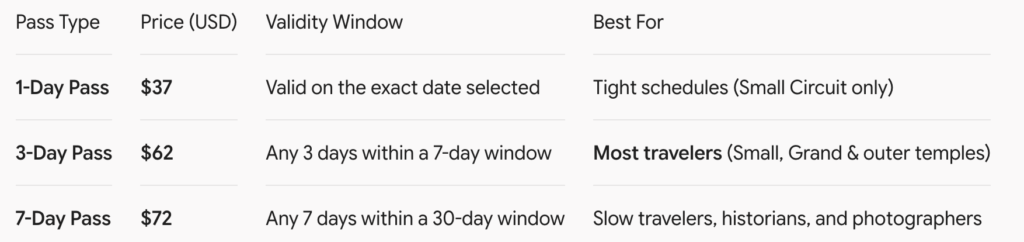
Where to Buy Angkor Tickets: Tickets are NOT sold at the temple gates.
You will have to show the tickets at the entrance of every temple, so keep them safe and handy.
Purchase online in advance at the official portal (to get a QR code on your phone) or in person at the Angkor Ticket Center on Road 60 in Siem Reap. Its easier to purchase the tickets at official Angkor Ticket centre as it is on the way towards temple complex. Avoid purchasing tickets from any other stores.
Google Map Location for Angkor Pass Official Counter: https://maps.app.goo.gl/vUAWC1MvUUa8XuwK7
Official Cambodia Government Portal for Temple Tickets: Link- https://www.angkorenterprise.gov.kh/en/available-tickets
3. Airport Transfers & Getting Around Siem Reap
How far is Siem Reap Airport from the city, and how do I reach my hotel?
Siem Reap Angkor International Airport (SAI) is roughly 45–50 km (about 1 hour) outside the city center.
Official Airport Shuttle Bus: Costs $8 USD per person (includes luggage) and drops you at the town station.
Shared Minivan Shuttle: Around $12 USD per person with direct hotel drop-off.
Private Airport Taxi: Around $35 USD. You can also ask your reserved hotel in advance to arrange a pickup.
How do I travel from my hotel to the Angkor temples?
All hotels are located in Siem Reap town, while the Angkor Archaeological Park lies a few kilometers north and spans over 400 sq km. Because temples are spread far apart, you need dedicated transport:
Private Tuk-Tuk (Most Popular): Hire a local tuk-tuk driver for the full day (including sunrise) for roughly $15–$25 USD for local circuits, or up to $35–$40 USD if adding distant outer temples like Banteay Srei.
Two-Wheelers & Bicycles: You can rent bicycles ($2–$5/day), electric scooters, or petrol mopeds/motorcycles in town. (Check local licensing rules before renting petrol bikes).
Private Air-Conditioned Car/Van: Best if traveling with family, senior citizens, or a larger group.
4. Must-See Temples, Architecture & Floating Villages
Which temples should I cover in a 3-day Angkor itinerary?
Day 1 (The Small Circuit): Sunrise at Angkor Wat (12th-century Vishnu temple turned Buddhist monument), the walled city of Angkor Thom (featuring Bayon Temple’s giant stone faces and the Terrace of the Elephants), and Ta Prohm (famous for massive silk-cotton tree roots gripping the ruins). If time permits, visit Baphuon, Phimeanakas, and the Terrace of the Leper King as they are very close to each other.
Day 2 (The Grand Circuit): Preah Khan, Neak Pean, Ta Som, East Mebon, and Pre Rup (great for sunset).
Day 3 (Outer Temples): Banteay Srei (10th-century Shiva temple renowned for intricate pink sandstone carvings) and the Roluos Group (Bakong, Preah Ko, Lolei—representing the earliest 9th-century Khmer architecture).
What else can I see in Siem Reap besides temples?
Visit Tonle Sap Lake (Southeast Asia’s largest freshwater lake) to take a boat tour through traditional stilt and floating villages like Kampong Phluk or Kampong Khleang.
5. Must-Visit Museums in Siem Reap & Phnom Penh
Which museums should I visit in Siem Reap?
Angkor National Museum: Essential for understanding Khmer history, Hindu-Buddhist iconography, and the Gallery of 1,000 Buddhas before or after visiting the ruins.
Charges: $12 USD for foreign adults (ages 12+), $6 USD for children (ages 6–11) and students with ID, free for children under 6, plus an optional $5 USD for an audio guide.
Google Map Location Link: https://maps.app.goo.gl/8N5uSEr3irFLps9R6
APOPO Visitor Center: A unique, moving 1-hour guided experience (~$10 USD) showcasing how trained African giant pouched rats (“HeroRATs”) detect active landmines across Cambodia.
Charges: $10 USD per person (which includes the 45–60 minute guided tour and live HeroRAT demonstration), and free for children under 10.
Which museums are worth visiting in Phnom Penh?
If your itinerary includes Cambodia’s capital, do not miss:
National Museum of Cambodia: Houses the world’s finest collection of Khmer stone and bronze sculptures from the pre-Angkorian and Angkorian eras.
Charges: $10 USD for foreign adults (18+), $5 USD for foreign youth (ages 10–17), and free for children under 10, plus an optional $5 USD for an audio guide (or ~$10 USD for a personal guide).
Google Location Link: https://maps.app.goo.gl/YFkc4jxAXAe7Rfdh9
Tuol Sleng Genocide Museum (S-21): A sobering historical memorial documenting the Pol Pot and Khmer Rouge regime.
(Note: Dress modestly and prepare for emotionally heavy exhibits).
Charges: $5 USD for foreign adults (18+), $3 USD for foreign youth (ages 10–17 with ID), and free for children under 10, plus an optional $5 USD for an audio guide (or a voluntary contribution for a live guide).
Google Location Link: https://maps.app.goo.gl/CEbyA3VcL444V4ZM6
6. Quick Practical Tips for Indian Travellers Visiting Cambodia
Temple Dress Code: Shoulders and knees must be covered at certain sacred areas and temples. Avoid sleeveless tops and shorts that fall above the knee when visiting temples, particularly sacred structures where access restrictions are enforced. Carry a light scarf or stole, but don’t assume it will always substitute for appropriate clothing.
Start Early: Leave your hotel by 4:45 AM if you want to witness sunrise at Angkor Wat. The mornings are relatively pleasant, but afternoons can be extremely hot. Consider taking a break between 12:00 PM and 3:00 PM before resuming sightseeing.
Connectivity & Internet: Buy a local tourist SIM or eSIM. Providers such as Smart, Cellcard and Metfone offer data packages. Having mobile internet is useful for communicating with your tuk-tuk driver, navigating and booking transportation.
Vegetarian Food: Vegetarian food is available in Siem Reap, particularly in tourist areas. Indian restaurants, vegetarian-friendly cafes and international restaurants offer several options. However, Cambodian cuisine frequently uses fish sauce, shrimp paste and other animal-based ingredients in dishes that may otherwise appear vegetarian. If you are strictly vegetarian, specifically ask for food without fish sauce, meat stock, oyster sauce or shrimp paste.
Indian Restaurants: Siem Reap has Indian restaurants serving North Indian, South Indian and vegetarian dishes. If you are travelling with family members who prefer familiar Indian food, finding Indian restaurants in the city is generally not difficult. Google Maps can help you locate restaurants near your hotel.
Non-Vegetarian Food: Cambodian cuisine offers a variety of non-vegetarian dishes, including fish, chicken, pork and beef. Popular dishes include fish amok, Khmer curry and lok lak. If you enjoy trying local food, Siem Reap offers plenty of opportunities to experience Cambodian cuisine.
Drinking Water: Avoid drinking untreated tap water. Carry bottled water, particularly during temple visits, as you will be walking extensively in the heat. Keep a couple of bottles with you in your tuk-tuk. Drivers will have bottles in their cold storage. Ask accordingly.
Currency: Cambodia’s official currency is the Cambodian riel, but US dollars are widely used in tourist establishments. Carry small US dollar notes, preferably in good condition. Torn, heavily damaged or excessively worn notes may be refused. You will often receive small change in Cambodian riel.
Indian Rupees: Do not assume Indian rupees will be accepted in Cambodia. Carry US dollars or withdraw money locally through ATMs, keeping withdrawal charges in mind.
Cards and Cash: Credit cards may be accepted in hotels, larger restaurants and establishments catering to tourists. However, tuk-tuks, local markets, smaller restaurants and roadside vendors generally prefer cash. Always keep some cash handy.
Power Adapters: Cambodia uses several types of electrical sockets. Indian plugs may work at some establishments, but compatibility isn’t guaranteed everywhere. Carrying a universal travel adapter is a sensible precaution.
Sun Protection: Carry sunscreen, sunglasses, a hat and comfortable clothing. The temple complex involves considerable walking, and large sections of the archaeological park offer limited shade.
Footwear: Wear comfortable footwear that you can walk in for several hours. Some temples involve uneven stone surfaces, steep staircases, tree roots and slippery surfaces. Avoid uncomfortable shoes that you haven’t worn before.
Mosquito Protection: Carry mosquito repellent, particularly if you are visiting temples surrounded by vegetation, exploring the countryside or taking excursions around Tonle Sap.
Tuk-tuk Fares: Agree on the price and itinerary with your tuk-tuk driver before starting your journey. Clarify whether the fare includes the entire day, sunrise, distant temples or additional stops.
Keep Temple Days Flexible: Do not attempt to visit every temple in a single day. The Angkor Archaeological Park is vast, and excessive sightseeing can become exhausting. Plan your itinerary geographically and allow yourself time to appreciate the monuments.
Nightlife and Pub Street: Pub Street and the surrounding areas are popular for restaurants, cafes, nightlife and evening strolls. Even if you are not interested in nightlife, the area is worth visiting for dinner and experiencing Siem Reap after sunset.
Photography: Photography is generally permitted at most temple sites, but respect restrictions where they are displayed. Avoid climbing on fragile structures or touching delicate sculptures merely to get a photograph.
Respect Local Culture: Cambodia is a predominantly Buddhist country. Dress respectfully, avoid disruptive behaviour at religious sites and be mindful when photographing monks, worshippers and locals.
7. Shopping in Siem Reap: Night Markets, Souvenirs and Bargaining
Visit the Night Markets: Siem Reap has several night markets where you can shop for souvenirs, handicrafts, clothing, paintings, jewellery, scarves and other locally made products. These markets are particularly lively in the evening and are worth visiting even if you aren’t planning to shop extensively.
Old Market (Phsar Chas): Located in central Siem Reap, the Old Market is a popular place to shop for souvenirs, local products, handicrafts, clothing and everyday Cambodian goods. It is also a good place to experience the city’s local market atmosphere.
What Should You Buy in Cambodia? Popular souvenirs include Cambodian silk and cotton scarves, traditional krama scarves, handicrafts, paintings, handmade accessories, locally produced pepper and souvenirs inspired by Khmer art and architecture.
Cambodian Silk: Silk products, scarves and textile-based souvenirs are popular purchases in Cambodia. However, check the quality and composition before purchasing, particularly if the seller claims a product is genuine silk.
Kampot Pepper: Cambodian pepper, particularly Kampot pepper, is a popular souvenir for food enthusiasts. If you intend to take it back to India, purchase properly packaged products and check applicable customs regulations.
Bargaining: Bargaining is common at many souvenir stalls and tourist-oriented markets. You can politely negotiate the price, but do so respectfully. Compare prices at different stalls before making expensive purchases. Bargaining is generally not expected at supermarkets, established restaurants or shops displaying fixed prices.
Compare Prices Before Buying: Many stalls sell similar products. If you are buying several souvenirs, take some time to compare prices rather than purchasing everything at the first shop you visit.
Avoid Buying Antiquities: Do not purchase archaeological artefacts, temple fragments, ancient sculptures or objects that may have been illegally excavated or exported. Buying or exporting cultural property without the necessary permissions can lead to serious legal complications.
Carry Cash for Shopping: Many market stalls prefer cash, particularly smaller US dollar notes or Cambodian riel. Do not assume every stall accepts credit cards.
Shop in the Evening: Night markets are generally best explored after your temple visits, when the temperatures are more comfortable. You can combine shopping with dinner, cafes and an evening stroll through central Siem Reap.