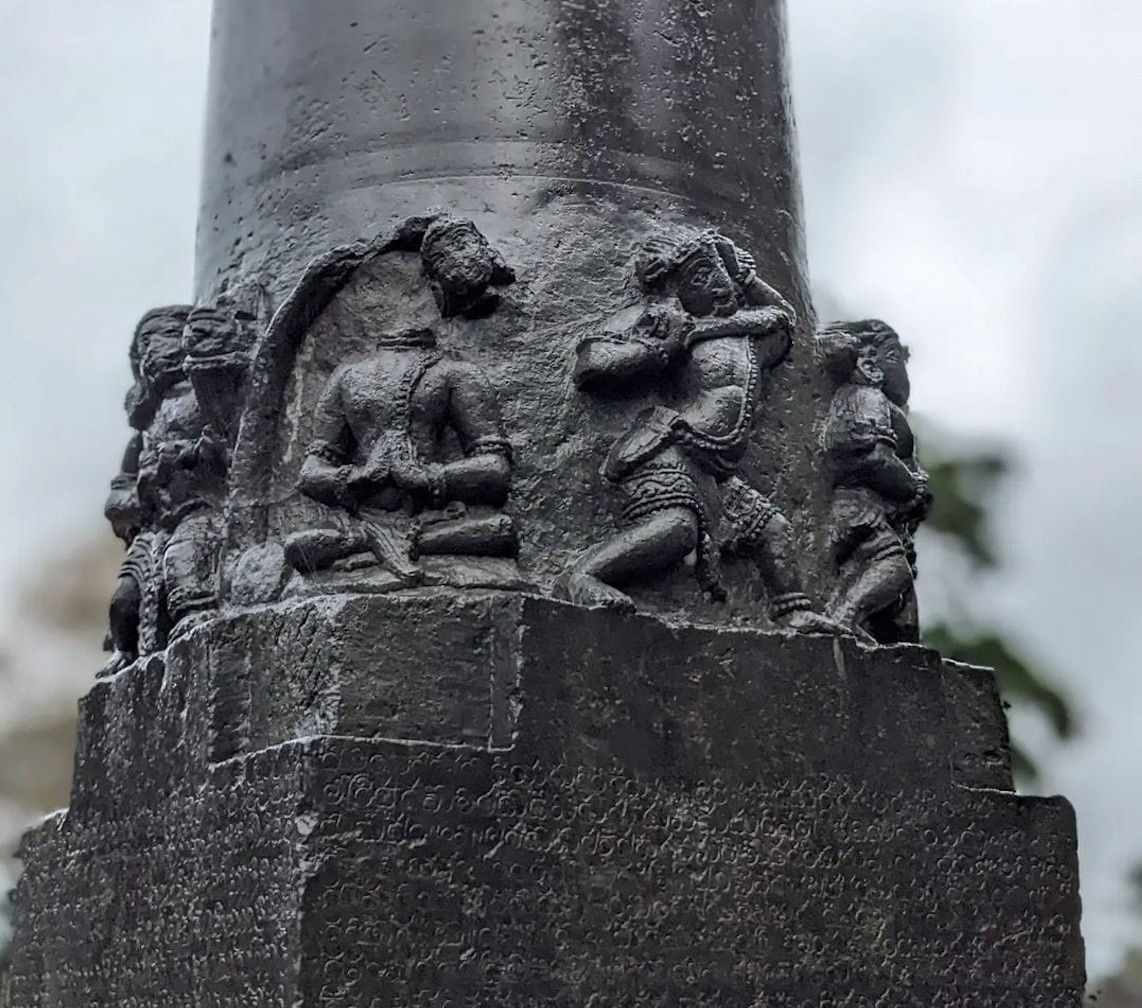
Among the many tales preserved within the Mahabharata, there are some whose influence reached far beyond the lands in which they were first remembered. For the great epic of India is not only a history of kings and wars, but also a treasury of narratives, ideas, and sacred memory that travelled across mountains and seas, taking root in distant realms.
Among these ancient stories is the tale of Jarasandha, the mighty king of Magadha, whose fall altered the political course of the epic age and whose final struggle was carved many centuries later upon the stones of a temple in Cambodia.
Thus the story of Jarasandha stretches across both time and geography. It begins with a miraculous birth, reaches its fulfilment in one of the most formidable duels described in the Mahabharata, and survives today in sculpture thousands of kilometres from the land where the tale was first told.
The Miraculous Birth of Jarasandha
In the days when Magadha was ruled by Brihadratha, there arose a great sorrow in the king’s house. Though he possessed wealth, authority, and a realm of considerable power, no son had been born to inherit his throne.
Therefore Brihadratha sought the blessings of the sage Chandakaushika, hoping that through the favour of the rishi his lineage might endure.
And it is said that when the king approached him, the sage sat deep in meditation beneath a tree. At that very moment a ripe mango fell from the branches above and came to rest upon the sage’s lap.
Chandakaushika perceived in this event a sign of divine grace, and he gave the fruit to Brihadratha as sacred prasada. The king returned to his palace and divided the mango into two equal portions, giving one half to each of his twin queens.
Thereafter both queens conceived.
Yet the fulfilment of the blessing came in a manner that none had foreseen.
For when the time of birth arrived, each queen brought forth only half of a child. From head to foot each infant was incomplete, lifeless, and malformed. Great fear fell upon the palace, and the queens, unable to bear the sight, ordered the two halves to be cast away beyond the city walls.
Now beyond the city there dwelt a rakshasi named Jara.
When she discovered the discarded portions, she lifted them and joined them together.
And lo, the moment the two halves touched, they became one body, and life entered the child.
Astonished by the wonder she had witnessed, Jara carried the infant before Brihadratha. And because it was through her act that Magadha received an heir, the child was named Jarasandha, meaning “the one joined by Jara.”
Yet in that strange beginning there lay hidden the secret of his end.
How Jarasandha Became the Most Powerful King of His Age
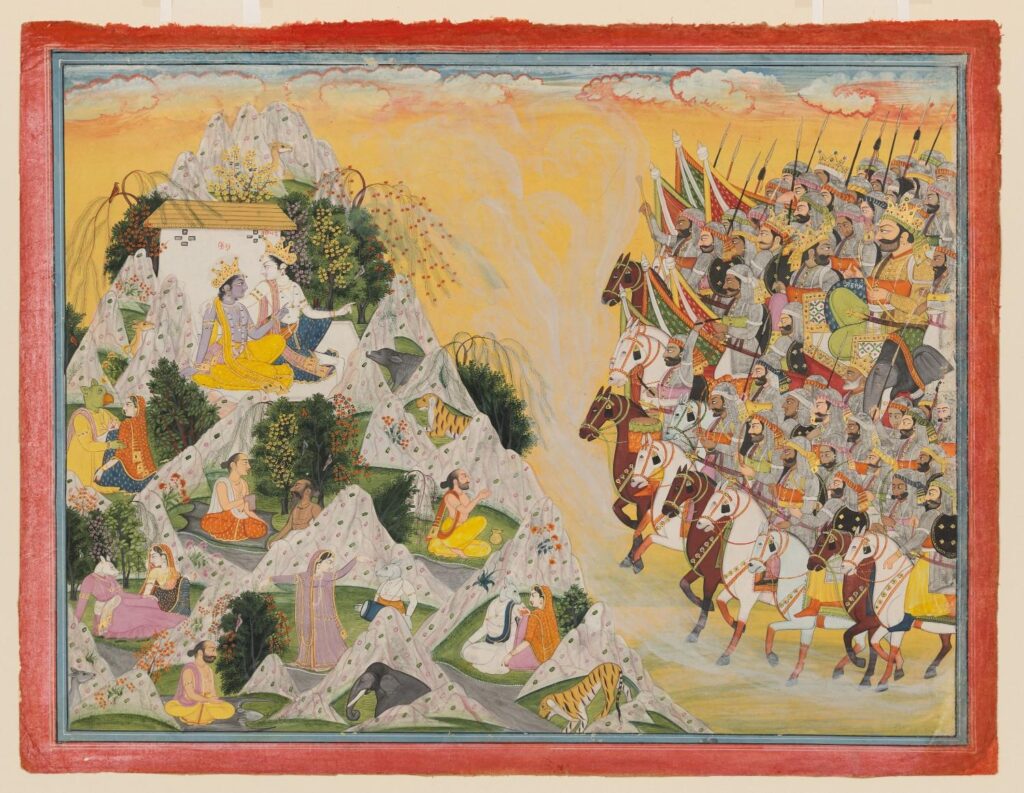
Period ca. 1800-1815, Geography- Kangra, Himachal Pradesh state, India
Smithsonian National Museum of Asian Arts.
As the years passed, Jarasandha grew into one of the most formidable rulers of his generation, and under his authority Magadha became a dominant power in northern India.
His influence spread through conquest, military strength, and alliances carefully forged among the rulers of the age.
Among these alliances, none proved more consequential than his connection with Kamsa, the ruler of Mathura, whose wife was Jarasandha’s daughter.
स तु लब्ध्वा बलं राजन्नुग्रसेनस्य सम्मतः । वसुदेवात्मजः सर्वैर्भातृभिः सहितं पुनः ।।
निर्जित्य युधि भोजेन्द्रं हत्वा कंसं महाबलः । अभ्यषिञ्चत् ततो राज्य उग्रसेनं विशाम्पते ।।
ततः श्रुत्वा जरासंधो माधवेन हतं युधि । शूरसेनाधिपं चक्रे कंसपुत्रं तदा नृपः ।।
स सैन्यं महदुत्थाप्य वासुदेवं प्रसह्य च । अभ्यषिञ्चत् सुतं तत्र सुताया जनमेजय ।।
-Jarasandh Vadh Parva, Sabhaparva, Mahabharat.
-In this way, gathering strength, the mighty Vasudevanandan Shri Krishna, as per the advice of Ugrasena, killed Bhojraj Kansa along with all his brothers and again anointed Ugrasena to the kingdom of Mathura. When Jarasandha heard that Shri Krishna had killed Kansa in the war, he made Kansa’s son the king of Shurasendesh. Janamejaya! He attacked with a huge army and defeated Vasudevanandan Shri Krishna and anointed his daughter’s son to the kingdom there.
When Krishna slew Kamsa, Jarasandha regarded the deed not merely as the death of an ally, but as an insult directed against his own house.
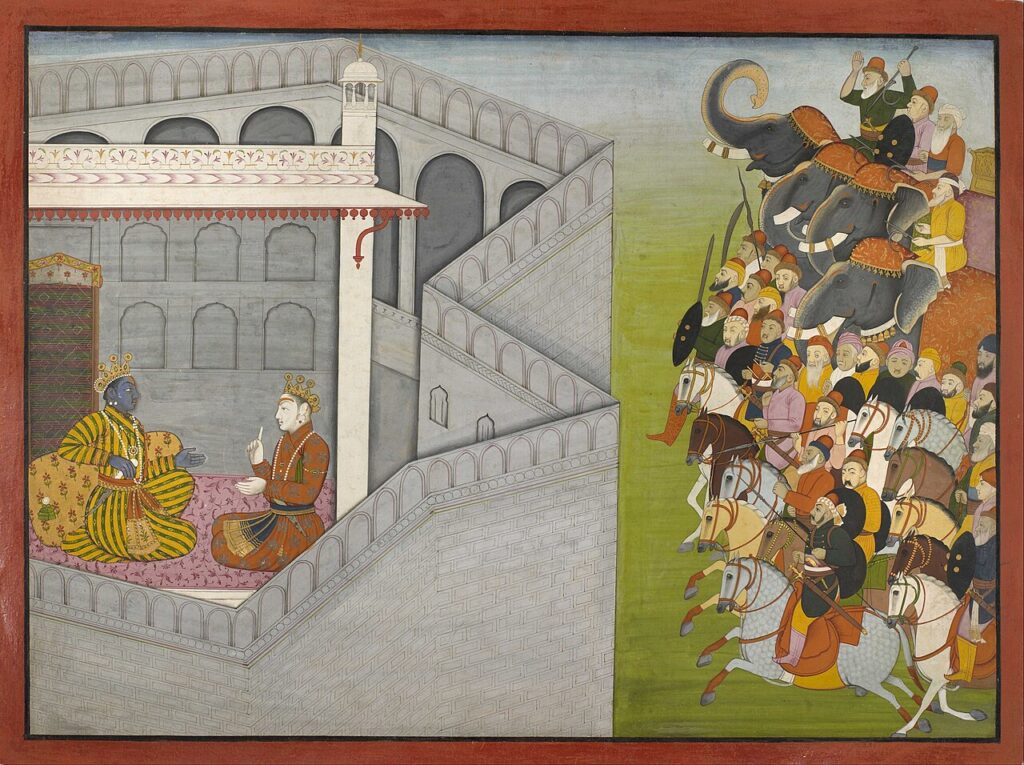
Date: 1769. Museum of Fine Arts, Houston.
Great was his anger.
Again and again he marched upon Mathura with vast armies. The Yadavas endured repeated assaults from the military power of Magadha, and in several encounters they suffered serious reverses. At length Krishna led the Yadavas westward and established their new stronghold at Dvaraka.
Thus Jarasandha’s fame spread throughout the lands.
Few kings dared oppose him.
For he seemed not merely powerful, but almost invincible.
Why Jarasandha Threatened Yudhishthira’s Rajasuya Sacrifice
In later years the fortunes of northern India were transformed by the rise of the Pandavas.
And when Yudhishthira had established himself at Indraprastha, he resolved to perform the Rajasuya sacrifice, the ancient imperial ritual through which a ruler proclaimed universal sovereignty.
Yet before such a rite could be completed, the great powers of the age had to acknowledge his supremacy.
And among all the obstacles that stood before him, none was greater than Jarasandha.
आशासितार्थे राजेन्द्र संरुरोध विनिर्जितान् । पार्थिवैस्तैर्नृपतिभिर्यक्ष्यमाणः समृद्धिमान् ।।
देवश्रेष्ठं महादेवं कृत्तिवासं त्रियम्बकम् ।
-Prosperous Jarasandha, wanted to worship the supreme god Mahadevji (known by the names Krittivasa and Trimbak), by sacrificing the kings of the world and to achieve this desired purpose, he had imprisoned all the kings he had conquered.
For the king of Magadha had imprisoned nearly eighty-eight monarchs, and according to the Mahabharata he intended to offer them as human sacrifices to Shiva in pursuit of still greater power and invincibility.
So long as Jarasandha remained undefeated, the imperial ambitions of Yudhishthira could never be fully realized.
Thus the problem before the Pandavas was not merely military, but political; and a direct invasion of Magadha promised a long and costly war.
Krishna’s Strategy Against the King of Magadha
But Krishna perceived what others did not.
He understood that Jarasandha could not be defeated through conventional warfare without immense loss of life. Magadha possessed a formidable army, and any campaign against it would consume countless warriors.
Therefore he chose not to strike first at the kingdom, but at the king himself.
Accompanied by Bhima and Arjuna, Krishna journeyed to Magadha disguised as a brahmana.
Upon their arrival the three heroes damaged structures associated with the Chaityaka hill and destroyed ceremonial drums, thereby making it plain that they had not come as ordinary guests.
Soon thereafter they stood before Jarasandha.
The king immediately discerned that these men were no true brahmanas. Yet bound by the sacred obligations of hospitality, he asked what they desired.
Then Krishna spoke openly.
Jarasandha was to choose one among them and meet him in single combat.
The challenge appealed directly to the king’s kshatriya pride.
And so he accepted.
Looking upon the three visitors, he chose Bhima.
Thus the fate of Magadha came to rest not upon armies, but upon two men.
Bhima vs Jarasandha: The Greatest Wrestling Match in the Mahabharata
The duel that followed stands among the most extraordinary combat episodes preserved in the Mahabharata.
Before the contest began, the two warriors observed the ancient courtesies of battle. They clasped hands in greeting, saluted one another according to custom, and acknowledged each other’s strength and honour. For though they had come together as enemies, each recognized in the other a champion worthy of renown.
Then the struggle commenced.
And the meeting of Bhima and Jarasandha was as the meeting of two mountains in wrath.
Both warriors were masters of malla-yuddha, the ancient Indian science of wrestling, and each possessed a strength that seemed beyond the measure of ordinary men. Arm-locks and leg-locks they employed, crushing embraces, throws and lifts, sweeps and grappling manoeuvres, each answering the skill of the other with equal force and determination.
The Sabha Parva preserves a vivid account of their contest, and there it is told that neither warrior could gain a decisive advantage.
Thus day followed day and night followed night, yet still they wrestled.
For thirteen consecutive days and nights the struggle endured. Dust rose from the arena beneath their feet, and the earth itself seemed to tremble under the force of their exertions. Those who watched looked on in wonder, beholding two of the mightiest men of the age testing the very limits of human endurance.
Yet no strength, however great, is beyond weariness.
Though to many it appeared that the contest remained evenly balanced, Krishna perceived what others did not perceive.
For Jarasandha was beginning to fail.
Ancient Wrestling Techniques in the Bhima–Jarasandha Duel
चित्रहस्तादिकं कृत्वा कक्षाबन्धं च चक्रतुः । गलगण्डाभिघातेन सस्फुलिङ्गेन चाशनिम् ।।
बाहुपाशादिकं कृत्वा पादाहतशिरावुभौ । उरोहस्तं ततश्चक्रे पूर्णकुम्भौ प्रयुज्य तौ ।
करसम्पीडनं कृत्वा गर्जन्तौ वारणाविव ।
सर्वातिक्रान्तमर्यादं पृष्ठभङ्गं च चक्रतुः । सम्पूर्णमूर्च्छा बाहुभ्यां पूर्णकुम्भं प्रचक्रतुः ।।
तृणपीडं यथाकामं पूर्णयोगं समुष्टिकम् । एवमादीनि युद्धानि प्रकुर्वन्तौ परस्परम् ।।
One detail often overlooked in modern retellings is that the Mahabharata does not describe the duel between Bhima and Jarasandha in vague terms.
The Sabha Parva preserves the names of several technical wrestling manoeuvres employed by the two warriors. These references provide a rare glimpse into the sophisticated world of ancient Indian malla-yuddha, where wrestling was not merely a test of strength but a highly developed martial science with its own specialized vocabulary.
Chitrahasta (चित्रहस्त)
The duel began with a display of rapid hand movements known as Chitrahasta.
The word literally means “varied” or “artful hand movements.” According to traditional explanations, the wrestlers repeatedly drew their arms inward, extended them outward, moved them above and below, and alternated between open palms and clenched fists.
This appears to have functioned as a form of hand-fighting, feinting, and positional probing, allowing each combatant to test the reactions and balance of his opponent before attempting a decisive hold.
Kaksha-bandha (कक्षाबन्ध)
Following this came Kaksha-bandha.
The term literally means “binding at the flanks” or “binding at the armpits.”
The commentators describe it as a manoeuvre in which each wrestler thrust both arms around the opponent’s sides, waist, or armpits in an attempt to secure control of the torso.
In modern wrestling terminology, it would resemble a powerful body lock or clinch designed to restrict movement and set up throws.
Gala-ganda-abhighata (गलगण्डाभिघात)
The text next describes blows directed toward the neck (gala) and cheeks (ganda).
These strikes were delivered with such force, says the epic, that sparks seemed to fly and sounds like thunder were produced.
Whether this description is partly poetic exaggeration or a literal reference to powerful open-handed strikes cannot be known with certainty, but it demonstrates that the contest involved more than grappling alone.
Bahu-pasha (बाहुपाश)
Another technique named in the text is Bahu-pasha, literally “the arm-noose.”
This appears to have involved trapping or entangling an opponent’s arm using one’s own arms, preventing effective movement while creating opportunities for throws, locks, or takedowns.
The imagery of a “noose” suggests a constricting hold designed to immobilize the adversary.
Charana-pasha / Pada Techniques (चरणपाश)
The duel also included techniques involving the legs and feet.
The commentary describes severe attacks delivered with the feet that caused pain deep within the body’s sinews and nerves.
These may have included leg-hooks, trips, sweeps, entanglements, and forceful kicks employed at close range during grappling exchanges.
Purna-kumbha (पूर्णकुम्भ)
One of the most intriguing techniques mentioned is Purna-kumbha, literally “the full pot.”
The traditional explanation states that the wrestler interlocked the fingers of both hands and then used the joined palms to press down upon the opponent’s head.
This would have allowed powerful downward pressure to be applied through the neck and spine while controlling posture and balance.
The name perhaps derives from the rounded shape formed by the interlocked hands.
Uro-hasta (उरोहस्त)
The text then refers to Uro-hasta.
Literally meaning “hand upon the chest,” this technique appears to have involved forceful blows, pushes, or strikes directed against the opponent’s chest.
Whether performed with open palms or otherwise, the purpose was likely to disrupt breathing, balance, and forward momentum.
Prishtha-bhanga (पृष्ठभङ्ग)
As the duel intensified, Bhima and Jarasandha employed a technique called Prishtha-bhanga.
The name means “breaking the back” or “forcing the back.”
The traditional gloss explains that each wrestler attempted to drive the other’s back to the ground.
In modern terms, this resembles a decisive pinning attempt, where victory depended upon overpowering the opponent’s balance and body position.
Sampurna-Murchha (सम्पूर्णमूर्च्छा)
The text also mentions Sampurna-Murchha.
The term suggests an attempt to render the opponent unconscious or incapacitated through sustained pressure, compression, or strikes directed toward vulnerable regions of the body.
The precise mechanics remain uncertain, but the objective appears clear: to overwhelm the opponent physically and mentally.
Trina-pida (तृणपीड)
Among the most fascinating manoeuvres is Trina-pida.
The traditional explanation compares the technique to twisting strands of grass together when making rope.
This suggests a painful twisting hold in which limbs, joints, or the entire body were torqued in opposite directions to break posture and inflict intense discomfort.
Purna-yoga with Mushtika (पूर्णयोगएवंमुष्टिक)
Finally, the text refers to Purna-yoga used together with Mushtika (fist-strikes).
The commentators explain this as a deceptive technique in which a wrestler feigned an attack against one part of the body before striking another.
In essence, it combined misdirection with punching—a sophisticated blend of strategy and physical skill.
What These Techniques Reveal
These technical terms remind us that the duel between Bhima and Jarasandha was not imagined merely as a contest of brute strength.
The Mahabharata presents both warriors as highly trained masters of malla-yuddha, employing a wide repertoire of grappling holds, clinches, strikes, pins, locks, feints, and submission techniques.
The episode therefore preserves something extraordinarily valuable: a glimpse into the martial culture of ancient India and into a wrestling tradition whose sophistication is often overlooked by modern readers.
How Krishna Revealed the Secret of Jarasandha’s Death
When Krishna saw that the appointed hour had come, he addressed Bhima.
No longer, he said, should the contest be prolonged.
And he reminded him of an old prophecy according to which the death of Jarasandha had long been destined to occur at Bhima’s hands.
भीमसेनस्ततः कृष्णमुवाच यदुनन्दनम् । बुद्धिमास्थाय विपुलां जरासंधवधेप्सया ।।
नायं पापो मया कृष्ण युक्तः स्यादनुरोधितुम् । प्राणेन यदुशार्दूल बद्धकक्षेण वाससा ।।
-Then Bhimasena, desiring the death of Jarasandha and taking counsel with his own great wisdom, turned to Yadunandana Shri Krishna and spoke, saying:
“O Yadushreshtha, behold Jarasandha, who has girded his waist firmly for the contest and stands unyielding in the struggle. Long have I wrestled with him, yet so long as life remains within his body, this sinful king appears beyond my power to subdue and cannot be brought beneath my mastery.”
एवमुक्तस्ततः कृष्णः प्रत्युवाच वृकोदरम् । त्वरयन् पुरुषव्याघ्रो जरासंधवधेप्सया ।।
यत् ते दैवं परं सत्त्वं यच्च ते मातरिश्वनः । बलं भीम जरासंधे दर्शयाशु तदद्य नः ।।
Then Shri Krishna, the Purushottama, perceiving Bhimasena’s uncertainty and desiring the fall of Jarasandha, spoke to him with words of encouragement:
“O Bhima, reveal now before us the full measure of that divine nature which abides within you, and the mighty strength bestowed upon you by Vayu, Lord of the Winds. Let that power, for which you are renowned among men, be displayed this day against Jarasandha, and let there be no further delay.”
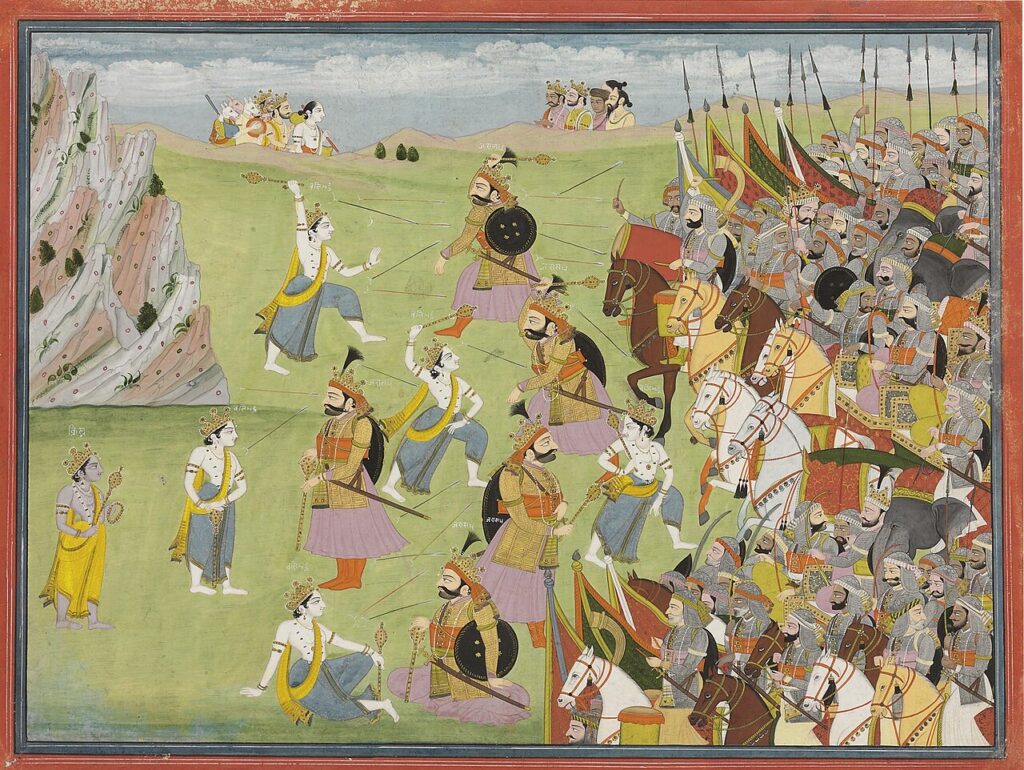
Circa 1810.
Doris Wiener Gallery, New York
तवैष वध्यो दुर्बुद्धिः जरासंधो महारथः । इत्यन्तरिक्षे त्वश्रौषं यदा वायुरपोह्यते ।।
गोमन्ते पर्वतश्रेष्ठे येनैष परिमोक्षितः । बलदेवबलं प्राप्य कोऽन्यो जीवेत मागधात् ।।
“That misguided yet mighty warrior, Jarasandha, is destined to meet his end at none but your hands. This I heard proclaimed from the heavens (Akashvani) themselves during an earlier war, at the very moment when Balarama sought to take the life of the king of Magadha.
Therefore was he spared upon the noble heights of Mount Gomanta. For his doom had not been appointed to come at the hands of Baladeva, but at yours.
Otherwise, had Jarasandha truly fallen within the grasp of Balarama, how could he possibly have survived? For once a foe came fully under the power of Baladeva, escape from destruction was scarcely to be hoped for.”
Yet even then Bhima did not understand how his adversary might be slain.
Therefore Krishna gave a silent sign.
Taking up a reed, he split it lengthwise into two pieces and cast them aside.
Bhima understood part of the meaning.
भ्रामयित्वा शतगुणं जानुभ्यां भरतर्षभ ।बभञ्ज पृष्ठं संक्षिप्य निष्पिष्य विननाद च ।।
करे गृहीत्वा चरणं द्वेधा चक्रे महाबलः ।।
Then Bhimasena understood the sign given by Shri Krishna.
Seizing Jarasandha, he whirled him a hundred times and hurled him violently to the ground. Bending his body like a great bow, Bhima struck his back with both knees and crushed him in a mighty embrace, uttering a roar like a lion upon the mountains.
Then, grasping one leg in his hand and pinning the other beneath his foot, the son of Vayu summoned all his strength and tore the king of Magadha asunder into two halves.
Then he seized Jarasandha, whirled him overhead many times, hurled him violently to the ground, and tore his body into two halves.
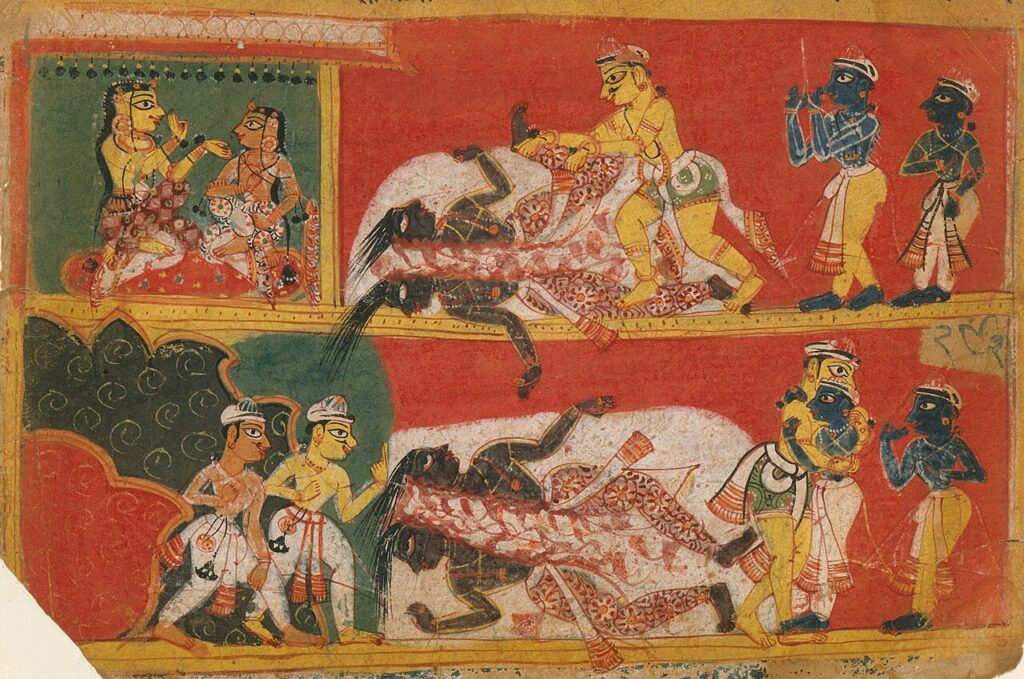
ca. 1520–40
Metropolitan Museum of Art.
But the effort came to nothing.
For even as he had been formed from two joined halves at birth, so too did Jarasandha’s divided body reunite. The severed portions came together once more, and the king rose again alive.
Thus the struggle resumed.
Then Krishna gave a second sign.
Again he took a reed and split it into two pieces.
But this time he cast the halves in opposite directions.
And at last Bhima understood completely.
Once more he seized Jarasandha and tore him apart. Yet now he did not leave the portions near one another. Instead he flung them far apart in opposite directions, so that they could never again be joined together.
Then the secret of Jarasandha’s birth became the instrument of his destruction.
This time there was no return.
And thus fell Jarasandha, king of Magadha.
The Political Consequences of Jarasandha’s Fall
Great were the consequences of Jarasandha’s death.
The imprisoned kings were released from captivity.
A formidable rival to Pandava power was removed.
And the path toward Yudhishthira’s Rajasuya sacrifice was at last made clear.
What could not have been achieved through a vast military campaign had been accomplished through a carefully engineered duel.
The episode also revealed the complementary strengths of Krishna and Bhima.
For Bhima possessed the physical power required to defeat Jarasandha, while Krishna supplied the strategic insight without which victory could never have been secured.
Neither alone would have been sufficient.
Together they achieved what had seemed impossible.
And thus was the balance of power in northern India transformed.
How Bhima Killed Jarasandha: Sculpture at Banteay Srei, Cambodia
Given the significance of this episode within the Mahabharata, one might expect numerous sculptural representations to survive across India.
Yet such depictions are surprisingly rare.
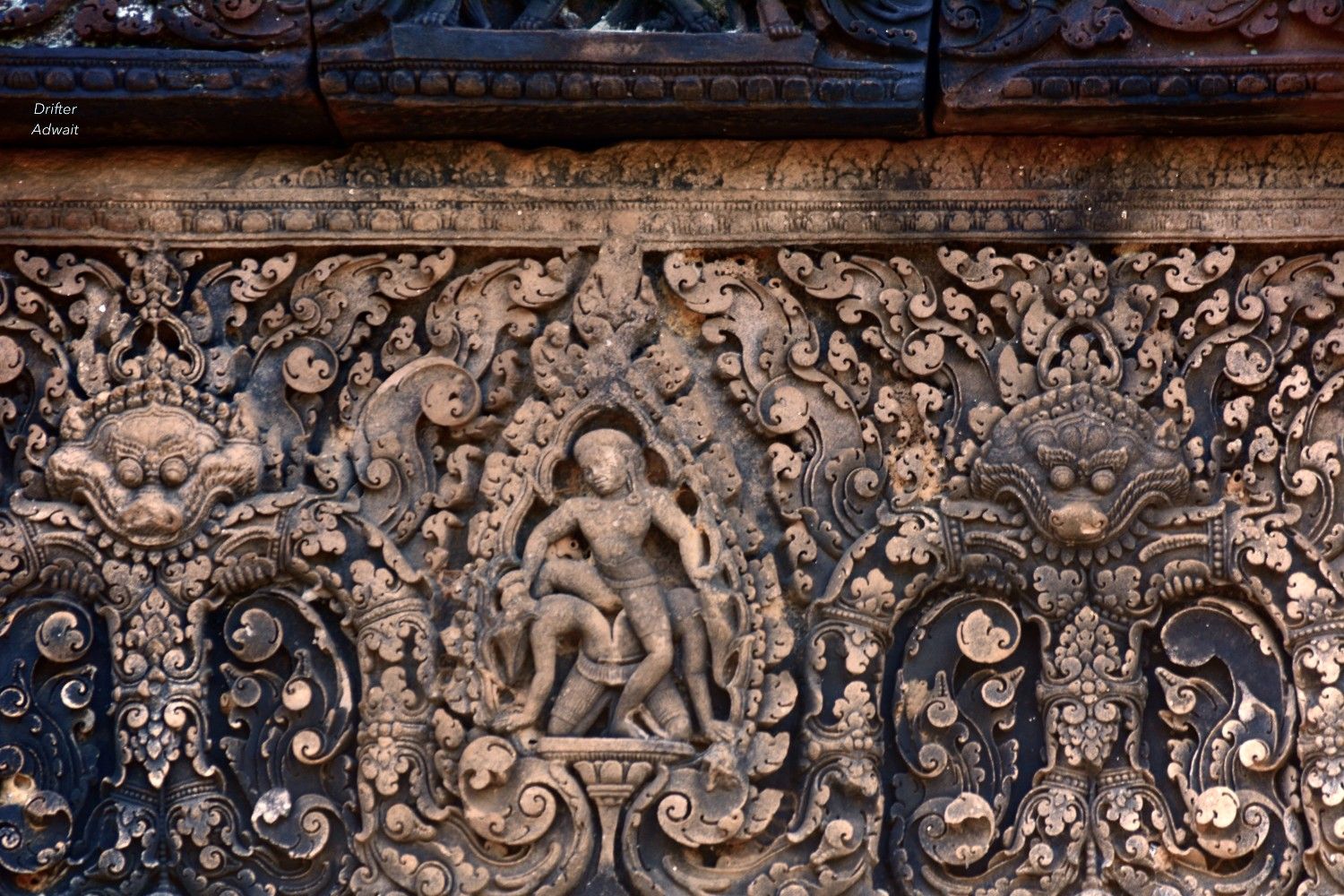
Indeed, one of the finest surviving examples is found not in India but in Cambodia, at Banteay Srei, originally known as Tribhuvanamaheshvara.
Constructed roughly a thousand years ago during the Khmer period, the temple contains some of the most sophisticated narrative carvings inspired by the Sanskrit epics.
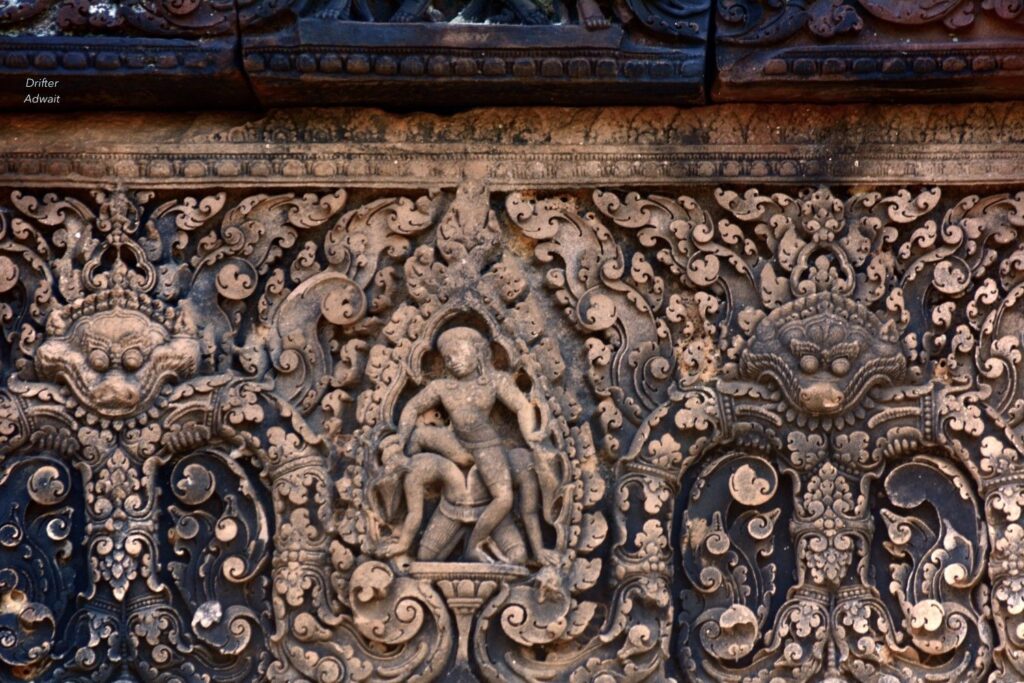
10th Centurey
Bante Srei Temple, Cambodia
Among these is a remarkable depiction of How Bhima Killed Jarasandha.
The scene is carved upon a temple pediment between two fearsome kirtimukhas, and there the sculptor has captured the very climax of the duel with extraordinary dramatic force.
Bhima appears as a massive and commanding figure. One leg is raised as he rends Jarasandha apart.
Beneath him kneels the king of Magadha, as though already aware that the hour appointed for his end has arrived.
Nor did the sculptor neglect the smaller details through which emotion is conveyed.
Jarasandha’s loosened hair, his strained posture, and his futile attempt to resist communicate helplessness and inevitability. Bhima’s stance, by contrast, expresses overwhelming physical dominance.
Thus the sculpture is more than a simple illustration of a mythological event.
It is a masterclass in narrative sculpture, in which movement, emotion, and storytelling are all preserved within stone.
Jarasandha and the Curious Journey of Khmer Antiquities
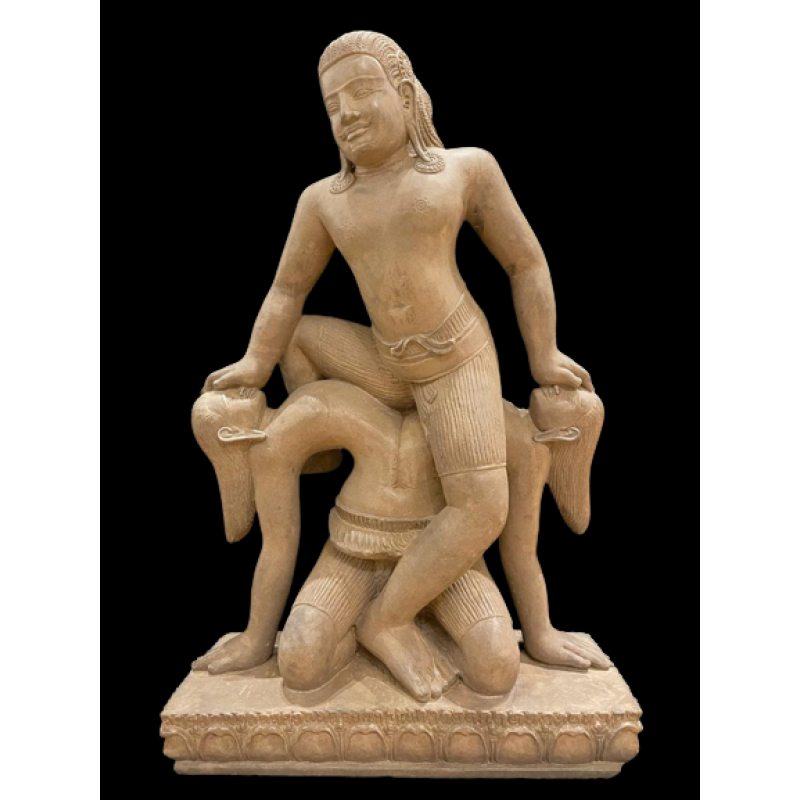
10th Century Cambodia
Shang Antique, Singapore.
Nor is Banteay Srei the only surviving Khmer representation of this episode.
A larger sculpture of the same subject has also come to light in modern times. While examining the collection presented by Shang Antique, a Singapore-based antiquities gallery, I encountered a remarkable tenth-century Khmer representation of Bhima and Jarasandha.
How this sculpture travelled from Cambodia to the wealthy art market of Singapore is a question that lies beyond the scope of this article. Perhaps specialists in the labyrinthine language of international antiquities law could explain the journey.
-They alone seem capable of transforming stories of movement, ownership, export, acquisition, and provenance into a vocabulary so polished that the object itself sometimes appears to have wandered across continents of its own accord.
Whatever the route by which it arrived there, the sculpture itself remains extraordinary.
Here again the sculptor chose the moment of Jarasandha’s destruction.
Bhima is depicted in the traditional Cambodian Sampot attire of the Khmer world. His powerful shoulders are adorned with ornaments that fall gracefully beside his face, while an imposing mass of carefully arranged hair and a distinguished moustache lend him an air of heroic dignity. Upon his countenance rests a restrained smile of triumph, subtle yet unmistakable.
Yet the achievement of the sculpture lies in more than its portrayal of Bhima’s strength.
For the sculptor did not concern himself solely with the victor.
With equal skill he captured the plight of Jarasandha.
One perceives in the defeated king not merely physical suffering, but also helplessness, desperate resistance, and the dawning realization that defeat has become inevitable. Thus the sculpture conveys two opposing emotional worlds at once: victory and defeat, ascent and downfall, heroic triumph and mortal vulnerability.
To balance such contrasting emotions within a single composition is no easy task. Yet the sculptor achieves it with remarkable assurance, transforming what might have been a simple representation of combat into a deeply human drama rendered in stone.
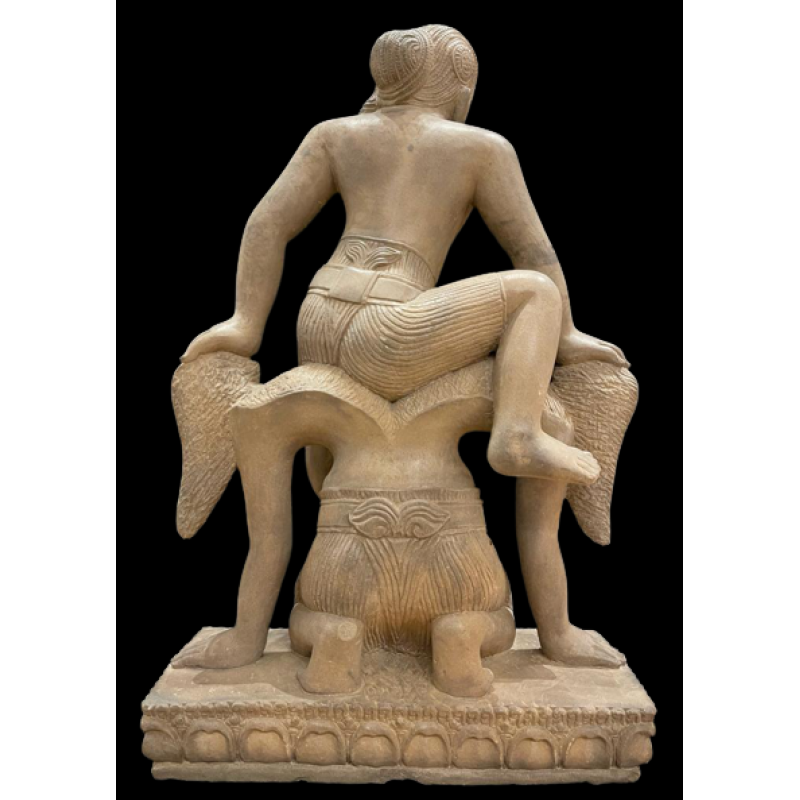
10th Century Cambodia
Shang Antique, Singapore.
What the Cambodian Sculpture Reveals About Indian Civilizational Influence
The existence of this sculpture gives rise to a question of considerable importance.How did a story born in the Gangetic plains of India come to be carved upon a temple wall in Cambodia?
The answer lies in the extensive cultural networks that connected South and Southeast Asia for many centuries.
Across the waters of the Bay of Bengal travelled merchants, monks, scholars, and royal envoys. With them travelled Indian texts, religious ideas, political concepts, artistic traditions, and languages.
Yet the societies that received these influences did not merely imitate them.
Rather, they adapted them, interpreted them, and made them their own.
The Khmer world did not simply copy Indian culture.
It absorbed it, transformed it, and reimagined it within its own cultural setting.
From this process emerged a shared civilizational sphere that extended across much of Asia.
And the Jarasandha panel at Banteay Srei stands as one of the clearest pieces of evidence for that remarkable phenomenon.
For it demonstrates how deeply the narratives of the Mahabharata became embedded within the artistic imagination of lands far beyond India itself.
Why the Story of Jarasandha Still Matters
At first glance, the death of Jarasandha may appear to be only one episode among many in the vast narrative of the Mahabharata.Yet the further one follows its consequences, the greater its significance becomes.
For had Jarasandha remained undefeated, Yudhishthira could never have completed the Rajasuya sacrifice.
Had the Rajasuya not been performed, the great assembly at Indraprastha would never have taken place in the form remembered by tradition.
Had that assembly never occurred, Duryodhana would not have wandered through the enchanted halls of the Maya Sabha, mistaking crystal floors for water and water for crystal. He would not have suffered humiliation before the gathered kings. And the wound dealt to his pride that day might never have festered into the bitterness that consumed him thereafter.
Yet from that wounded pride flowed many other events.
The game of dice.
The exile of the Pandavas.
The long years of resentment and preparation.
And finally Kurukshetra.
Thus the death of Jarasandha stands far closer to the great war than might at first appear.
For remove this single event from the chain, and much that followed becomes uncertain.
Indeed, one may even venture a greater speculation.
Had Kurukshetra never been fought, the world would never have heard the Bhagavad Gita as it is known today.
For it was upon that battlefield, in the terrible stillness before the armies met, that Krishna revealed to Arjuna one of the most influential spiritual teachings in human history.
Without the fall of Jarasandha, there would have been no Rajasuya.
Without the Rajasuya, no humiliation in the Maya Sabha.
Without that humiliation, perhaps no dice game.
Without the dice game, perhaps no Kurukshetra.
And without Kurukshetra, no Bhagavad Gita.
Of course, such reflections belong not to history but to the realm of possibility.
For the Mahabharata repeatedly suggests that certain events move according to a design greater than the intentions of kings and warriors.
Had Jarasandha not fallen at Bhima’s hands, perhaps Krishna would have found another path toward the restoration of dharma.
Yet that path was not the one remembered by tradition.
The path that survives in epic memory begins here: with a king of Magadha who was born from two halves, ruled as one of the most powerful monarchs of his age, and whose death set in motion events that would culminate in the greatest war of the ancient Indian imagination.
And so the sculptors of Cambodia, though separated by centuries and oceans from the world of the Mahabharata, may have understood something profound.
They chose not to carve an obscure episode.
They chose to carve one of the turning points upon which the destiny of the epic itself depended.
For when Bhima tears Jarasandha apart upon the stones of Banteay Srei, we are witnessing more than the fall of a king.
We are witnessing one of the first great movements in the long chain of events that would eventually lead to Kurukshetra, to the Bhagavad Gita, and to the restoration of dharma itself.
References:
1. Geeta Press Gorakhpur, Mahabharata. By Pandit Ramnarayandat Shastri Panday
2. Shang Antique, Singapore.
Frequently Asked Questions
- How did Bhima kill Jarasandha in the Mahabharata?
The story of how Bhima killed Jarasandha reaches its climax after Krishna reveals the secret of the king’s miraculous birth. Bhima tears Jarasandha into two halves and throws them in opposite directions, preventing the body from reuniting and ending the mighty king’s life.
- Why did Krishna help Bhima kill Jarasandha?
Understanding how Bhima killed Jarasandha also explains Krishna’s strategy. Jarasandha had imprisoned nearly eighty-eight kings and stood as the greatest obstacle to Yudhishthira’s Rajasuya sacrifice. Krishna therefore chose strategy over open warfare.
- How long did Bhima and Jarasandha wrestle before Bhima killed Jarasandha?
Before Bhima killed Jarasandha, the two warriors wrestled continuously for thirteen days and thirteen nights. The Mahabharata describes their duel as one of the greatest displays of ancient Indian malla-yuddha.
- Where can you see sculptures showing how Bhima killed Jarasandha?
One of the finest depictions of how Bhima killed Jarasandha survives at the Khmer temple of Banteay Srei in Cambodia. Another remarkable tenth-century Khmer sculpture of the same episode has also surfaced in the modern antiquities market.
- Why is the story of how Bhima killed Jarasandha important?
The story of how Bhima killed Jarasandha changed the course of the Mahabharata. Jarasandha’s death enabled Yudhishthira to perform the Rajasuya sacrifice, setting in motion the events that ultimately led to the Maya Sabha, the humiliation of Duryodhana, the Kurukshetra War, and the revelation of the Bhagavad Gita.